 ®
®PET, Carrierless, Foam & Specialty Bonding Tapes
A structured portfolio of PET double-sided tapes, carrierless transfer tapes, tissue tapes, LSE bonding tapes, foam tapes, differential silicone/acrylic tapes, light-blocking materials and heat-activated bonding films. Select by adhesive chemistry, carrier, thickness, joint geometry, restoring force and rework requirements. Each construction serves a distinct bonding role.
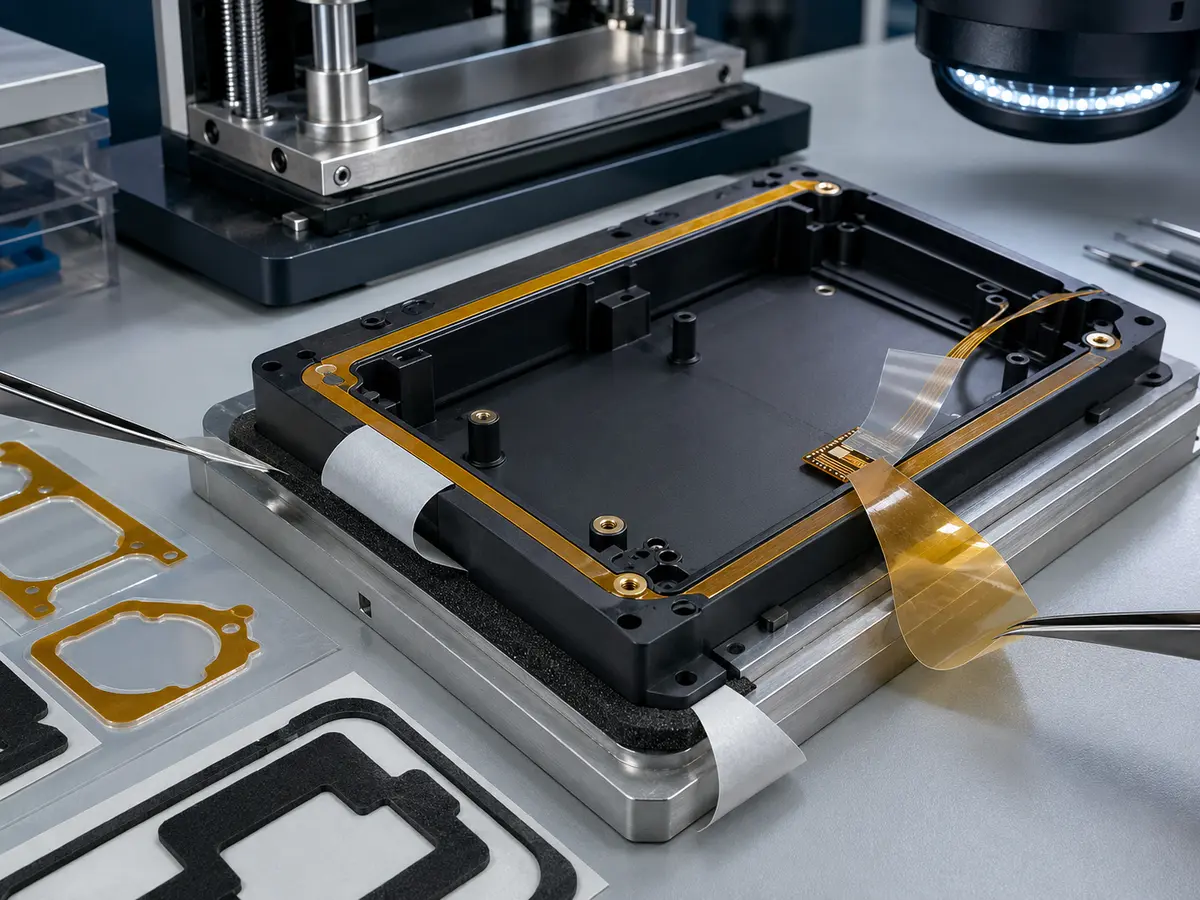
What the material stack contains.
Read the layers in functional order; the exact construction remains grade-specific.
- 01PET, tissue, acrylic foam, PE foam, PU foam or carrierless adhesive platform
- 02Acrylic, silicone, rubber or heat-activated adhesive selected by substrate
- 03Single-, double- or differential-sided construction
- 04Paper or film release liner with controlled converting orientation
Named grades for technical selection.
Each ECLEAR model identifies a distinct material role and construction. Manufacturing cross-references remain controlled in the ECLEAR product master for traceability.
Permanent bonding depends on wet-out, stress distribution and interface durability.
01PET double-sided, carrierless transfer, foam, low-surface-energy, differential and light-blocking tapes solve different assembly problems. Carrier thickness, adhesive chemistry, compressibility, color and release construction must stay linked to a specific ECLEAR grade.
02Initial tack is not the same as durable adhesion. Wet-out develops with pressure, dwell and temperature, while surface energy, contamination, plasticizers, curvature and restoring force determine the long-term interface.
03Hot-melt and thermosetting films add temperature, pressure and cure history to the bond design. The finished bondline is qualified for the actual substrate, geometry, load and environmental cycle.
Performance framed around the application.
Benefits are evaluated on the intended substrate, process and finished assembly.
Thin carrierless tapes for conformable and curved-surface bonding
PET and LSE systems for high shear, anti-lifting and PP/PE interfaces
Foam families for cushioning, sealing, repair and foldable-device support
Differential and heat-activated constructions for dissimilar materials
From material definition to a qualified production stack.
Qualification links the material, converting route and customer production line.
Record substrates, bond area, gap, load direction, thickness and rework needs.
Control cleaning, activation, primer and time before lamination.
Set pressure, dwell, alignment and any heat/cure cycle.
Verify peel, shear, creep, lifting, appearance and environmental durability.
Evidence to collect before specification release.
Use representative substrates, process conditions and aging sequences.
- Peel and dynamic/static shear on both production substrates
- Gap filling, compression recovery and edge lift on actual geometry
- High/low temperature, humidity, thermal cycling and chemical exposure
- Light-blocking, electrical or flame properties where the grade provides that function
- Reworkability, residue and damage where controlled removal is required
Values require a method and an approved revision.
Typical values support selection; controlled specifications come from the approved TDS.
Typical values are not specifications. Final limits are subject to the approved ECLEAR TDS and customer validation.
Questions engineers ask before a line trial.
Resolve the material role, interfaces and process window before sampling.
Why are similar tape models kept separate?+
A one-letter or thickness change can identify a different carrier, adhesive, side construction, color, release system or application window. ECLEAR does not treat those variants as interchangeable.
Can a high peel value guarantee a reliable device bond?+
No. Peel, shear, creep, impact, gap filling, restoring force and environmental aging represent different failure modes. The joint must be tested in its real geometry.
Can ECLEAR recommend a grade from an application description alone?+
A first shortlist is possible, but a production recommendation requires the substrate, layer construction, equipment, process sequence, test method and acceptance criteria. ECLEAR normally moves from requirement definition to laboratory matching, samples, line trial and a frozen approved specification.
Are the values shown on this page guaranteed specifications?+
No. Website values and constructions are selection guidance. Guaranteed limits, test conditions, packaging and shelf life are controlled only by the latest ECLEAR-approved TDS, quality agreement and customer qualification record.
Where this platform is evaluated.
Each application still requires stack-level compatibility and line validation.
Parameters to control.
Record the complete process window, not only one nominal setting.
- Identify both substrates, surface energy, roughness and contamination.
- Set die-cut geometry, liner sequence, pressure, dwell and temperature.
- Test static shear, push-out, spring-back and environmental aging on the assembly.
- Define repair or removal requirements before selecting a permanent adhesive.
What we need to know.
These inputs allow ECLEAR to narrow the grade and validation plan.
- Q1Are both bonding surfaces high-energy, silicone, foam, fabric or LSE plastic?
- Q2What bondline thickness, gap filling and cushioning are required?
- Q3What shear, push-out, sealing and anti-repulsion targets apply?
- Q4Must the joint be permanent, reworkable or heat activated?
What a disciplined trial should expose early.
Early failure checks reduce scale-up risk and prevent false material comparisons.
Selecting by peel alone while ignoring shear and spring-back
Using the wrong adhesive face in a differential construction
Poor wet-out on rough, contaminated or low-energy substrates
Uncontrolled liner changes that alter die-cut or lamination behavior
Controlled technical documents.
Request the current revision for the selected ECLEAR grade and application.
Typical constructions and application concepts are provided for material selection only. Availability, structure, performance and process conditions are grade-specific and subject to the latest ECLEAR-approved TDS, application testing and final customer qualification.
Related material systems.
Review adjacent materials that interact with this product in the same stack or process.
Validate the complete stack, not one isolated material.
Share the substrate, construction, process and acceptance criteria for a focused recommendation.