 ®
®ECLEAR Anti-Reflection & Four-Way Privacy Films
EC-OF-AR-101 combines an optical PET base with a hard-coated anti-reflection and anti-fingerprint surface for high-transmission display interfaces. EC-OF-PV4-101 uses a single-film micro-louver structure to reduce off-axis visibility from above, below, left and right.
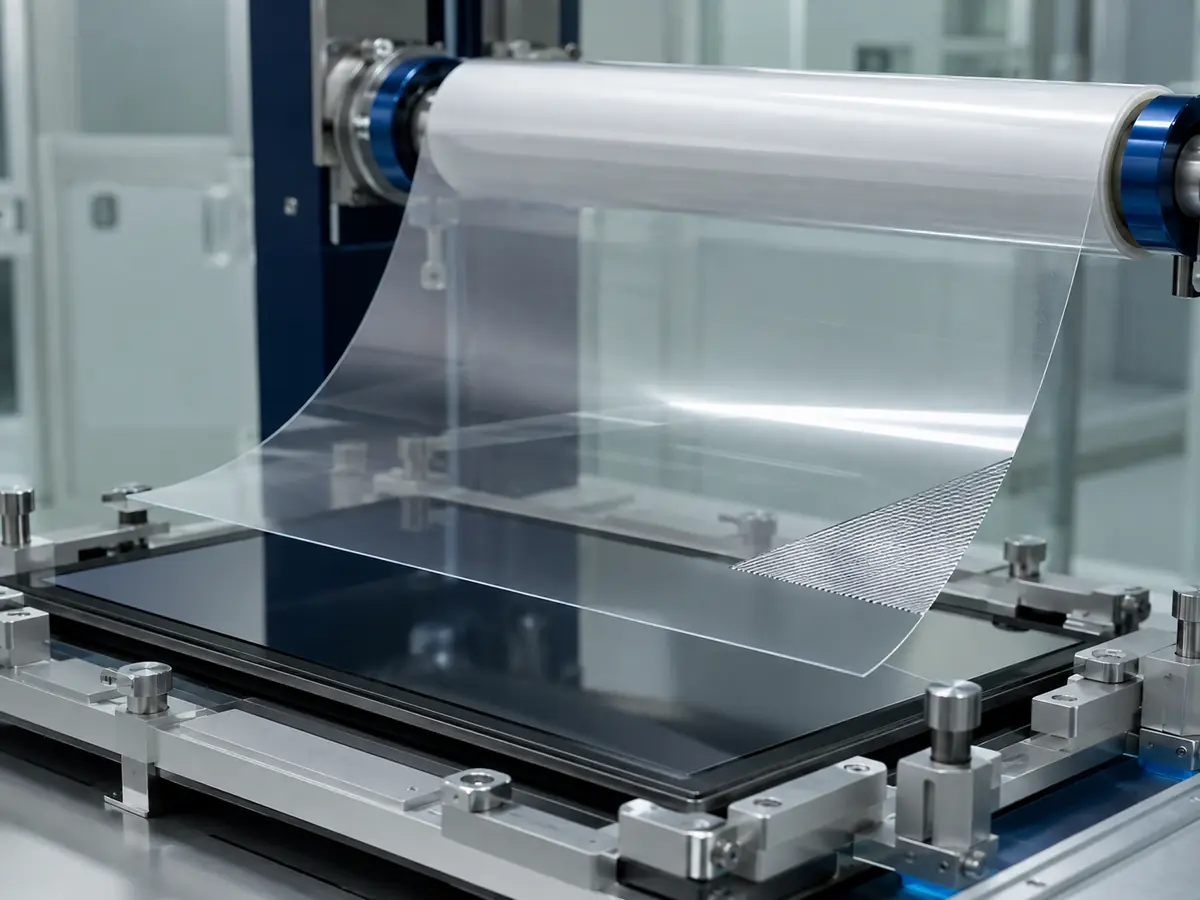
What the material stack contains.
Read the layers in functional order; the exact construction remains grade-specific.
- 01EC-OF-AR-101: removable protection film / integrated hardcoat, anti-reflection and anti-fingerprint surface / 50 µm optical PET base
- 02EC-OF-PV4-101: single-film micro-louver structure with PET support, hardcoat and removable protection liners
- 03Optional pressure-sensitive adhesive is supplied only in a separately identified construction
- 04Protection liners are removed at the specified assembly step; confirm installed thickness and adhesive construction on the approved drawing
Named grades for technical selection.
Each ECLEAR model identifies a distinct material role and construction. Manufacturing cross-references remain controlled in the ECLEAR product master for traceability.
Finished PET films add controlled optical functions at the display interface.
01EC-OF-AR-101 is a finished optical PET film produced by wet coating. Its hard-coated anti-reflection and anti-fingerprint surface is designed for high transmission and low haze. Wet coating describes the film manufacturing process; this product is supplied as film rather than coating liquid.
02The anti-reflection layer is designed so reflections generated at adjacent optical interfaces partially cancel through destructive interference. Refractive index, optical thickness, wavelength and viewing angle all affect the installed result, so the cover, adhesive, polarizer and display interfaces are evaluated together.
03EC-OF-PV4-101 uses a single-film micro-louver structure to limit off-axis light above, below, left and right of the display. The nominal 38° reference does not define a guaranteed blackout threshold or a 38° total viewing cone. Specify the viewing map, display brightness, observation distance and installed stack before approval.
Performance framed around the application.
Benefits are evaluated on the intended substrate, process and finished assembly.
Named ECLEAR grades for anti-reflection and four-direction privacy functions
Wet-coated AR film combines low reflection, high transmission and an anti-fingerprint surface
Single-film privacy structure limits off-axis viewing along both display axes
Finished films for controlled converting and display lamination; confirm roll or sheet format by grade
From material definition to a qualified production stack.
Qualification links the material, converting route and customer production line.
Define reflection, transmission, haze or privacy viewing-angle targets.
Confirm cover, adhesive, polarizer, air-gap and display interfaces.
Control roll direction, die cutting, protective-liner removal and particles.
Measure optics, viewing geometry, cosmetics, durability and environmental aging.
Evidence to collect before specification release.
Use representative substrates, process conditions and aging sequences.
- Spectral and luminous transmittance with the complete instrument method
- Reflectance at defined wavelength, incidence and backing condition
- Haze, image clarity and privacy viewing map on the final display stack
- Protective-liner peel, release and contamination after aging
- Hardcoat durability, easy-clean contact angle and surface appearance
Values require a method and an approved revision.
Typical values support selection; controlled specifications come from the approved TDS.
Typical values are not specifications. Final limits are subject to the approved ECLEAR TDS and customer validation.
Questions engineers ask before a line trial.
Resolve the material role, interfaces and process window before sampling.
Is wet-coated AR film a liquid optical coating?+
No. EC-OF-AR-101 is delivered as a finished PET functional film. Wet coating describes the precision manufacturing route used to build its optical surface layers.
What does four-way privacy mean?+
EC-OF-PV4-101 reduces off-axis visibility from above, below, left and right while retaining a frontal viewing region. It does not mean complete invisibility from every direction; the result depends on the display, lighting, distance and layer stack.
Can ECLEAR recommend a grade from an application description alone?+
A first shortlist is possible, but a production recommendation requires the substrate, layer construction, equipment, process sequence, test method and acceptance criteria. ECLEAR normally moves from requirement definition to laboratory matching, samples, line trial and a frozen approved specification.
Are the values shown on this page guaranteed specifications?+
No. Website values and constructions are selection guidance. Guaranteed limits, test conditions, packaging and shelf life are controlled only by the latest ECLEAR-approved TDS, quality agreement and customer qualification record.
Where this platform is evaluated.
Each application still requires stack-level compatibility and line validation.
Parameters to control.
Record the complete process window, not only one nominal setting.
- Define spectral range, incidence angle, backing and display stack before comparing reflectance; confirm the adhesive-coated variant separately.
- For privacy film, lock microlouver orientation to the display axes before die cutting.
- Qualify optical performance on the assembled display rather than a film coupon alone.
- Control web direction, particles, protective-liner removal, lamination and final inspection.
What we need to know.
These inputs allow ECLEAR to narrow the grade and validation plan.
- Q1Is the priority low reflection, four-way viewing privacy or a separately validated combination?
- Q2What cover, OCA, polarizer and display interfaces form the final stack?
- Q3What haze, image-clarity, hardness and easy-clean limits apply?
- Q4How will the film be converted, stored and laminated?
What a disciplined trial should expose early.
Early failure checks reduce scale-up risk and prevent false material comparisons.
Confusing anti-reflection interference with matte anti-glare scattering
Optical shift caused by angle, backing or unreported instrument geometry
Particles, scratches or release contamination introduced during converting
Treating a nominal privacy angle, inconsistent layer totals or brochure comparison figures as guaranteed installed specifications
Controlled technical documents.
Request the current revision for the selected ECLEAR grade and application.
Typical constructions and application concepts are provided for material selection only. Availability, structure, performance and process conditions are grade-specific and subject to the latest ECLEAR-approved TDS, application testing and final customer qualification.
Related material systems.
Review adjacent materials that interact with this product in the same stack or process.
Validate the complete stack, not one isolated material.
Share the substrate, construction, process and acceptance criteria for a focused recommendation.