 ®
®Hydrophobic & Oleophobic Coatings
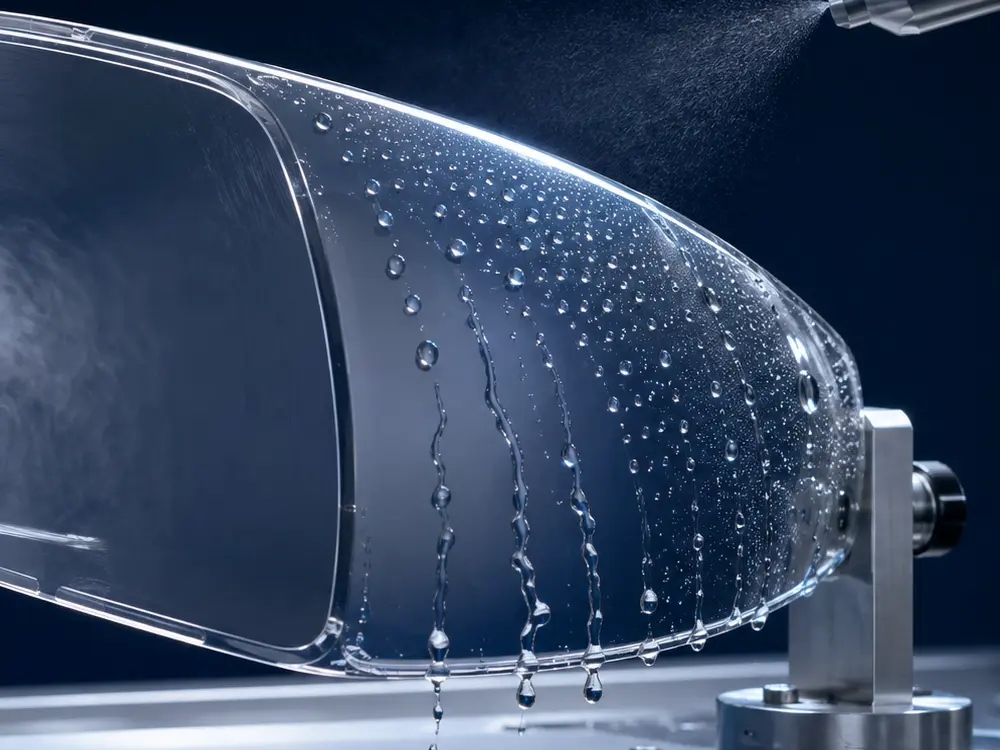
ECLEAR develops fluorine-based hydrophobic systems for qualified hardcoated or metallized polycarbonate and acrylic lens surfaces, with additional polymer and glass compatibility assessed by project. The treatment promotes water beading and roll-off while creating a smoother, easier-to-clean surface.
What the material stack contains.
Read the layers in functional order; the exact construction remains grade-specific.
- 01Qualified substrate or hardcoat
- 02Optional activation/primer interface
- 03Thin hydrophobic or oleophobic topcoat
Lower surface energy for water beading and easier cleaning.
01A hydrophobic topcoat changes the interaction between the exposed surface and water. Instead of spreading, a droplet forms a higher contact angle and can roll away more readily when gravity, airflow or wiping force is applied.
02Oleophobic and easy-clean performance are related but not identical to water repellency. Oils, fingerprints and cleaning agents have different surface tensions, so each target should be measured with an appropriate liquid, method and durability sequence.
03The topcoat is thin and interface-sensitive. Contamination, incomplete activation, excessive coating mass or incompatibility with a hardcoat, PVD film or ink can reduce adhesion or create optical non-uniformity.
Performance framed around the application.
Benefits are evaluated on the intended substrate, process and finished assembly.
Water beading and roll-off
Reduced adhesion of fingerprints, smudges and grime
Easier cleaning on qualified surfaces
Integration support for hardcoat and metallized stacks
From material definition to a qualified production stack.
Qualification links the material, converting route and customer production line.
Identify hardcoat, metalized surface, polymer or glass and its cleaning history.
Control surface energy, activation and time before coating.
Stabilize coating mass, uniformity and the approved cure route.
Measure water, oil and easy-clean behavior after relevant wear and chemicals.
Evidence to collect before specification release.
Use representative substrates, process conditions and aging sequences.
- Static or dynamic water-contact angle using a defined droplet volume
- Roll-off or sliding-angle test on the intended part orientation
- Fingerprint, oil and cleaning evaluation with controlled materials
- Abrasion and chemical durability of retained easy-clean performance
- Optical appearance and intercoat adhesion on the finished stack
Values require a method and an approved revision.
Typical values support selection; controlled specifications come from the approved TDS.
Typical values are not specifications. Final limits are subject to the approved ECLEAR TDS and customer validation.
Questions engineers ask before a line trial.
Resolve the material role, interfaces and process window before sampling.
Is contact angle alone enough to select an easy-clean coating?+
No. Contact angle is useful, but roll-off, hysteresis, oil interaction, abrasion durability and compatibility with the underlying stack are also important.
Can the coating be used on both polymer and glass?+
The public platform includes qualified hardcoated or metallized PC and acrylic surfaces, with other polymers and glass evaluated project by project.
Can ECLEAR recommend a grade from an application description alone?+
A first shortlist is possible, but a production recommendation requires the substrate, layer construction, equipment, process sequence, test method and acceptance criteria. ECLEAR normally moves from requirement definition to laboratory matching, samples, line trial and a frozen approved specification.
Are the values shown on this page guaranteed specifications?+
No. Website values and constructions are selection guidance. Guaranteed limits, test conditions, packaging and shelf life are controlled only by the latest ECLEAR-approved TDS, quality agreement and customer qualification record.
Where this platform is evaluated.
Each application still requires stack-level compatibility and line validation.
Parameters to control.
Record the complete process window, not only one nominal setting.
- Validate cleanliness and surface energy immediately before application.
- Control coating mass, uniformity and cure according to the approved grade.
- Measure initial and aged easy-clean performance after the relevant abrasion and chemical cycles.
- Confirm compatibility with adjacent anti-fog, AR, PVD and ink layers.
What we need to know.
These inputs allow ECLEAR to narrow the grade and validation plan.
- Q1What is the exposed surface chemistry?
- Q2Is the priority water repellency, oil repellency, easy cleaning or all three?
- Q3Which cleaners and abrasion cycles represent real use?
- Q4What optical and appearance limits apply?
What a disciplined trial should expose early.
Early failure checks reduce scale-up risk and prevent false material comparisons.
Poor adhesion on a contaminated or low-energy surface
Loss of performance after an unrepresentative abrasion test
Optical non-uniformity from excessive coating mass
Incompatibility with PVD, ink or another functional layer
Controlled technical documents.
Request the current revision for the selected ECLEAR grade and application.
Typical constructions and application concepts are provided for material selection only. Availability, structure, performance and process conditions are grade-specific and subject to the latest ECLEAR-approved TDS, application testing and final customer qualification.
Related material systems.
Review adjacent materials that interact with this product in the same stack or process.
Validate the complete stack, not one isolated material.
Share the substrate, construction, process and acceptance criteria for a focused recommendation.