 ®
®ECLEAR Anti-Fog Coating Systems
ECLEAR anti-fog systems control condensed moisture by promoting a continuous water film instead of discrete light-scattering droplets. FC-100 is positioned for qualified unprimed polycarbonate applications. FT-100 follows a different route for plasma-treated, hardcoated polycarbonate and must be specified independently.
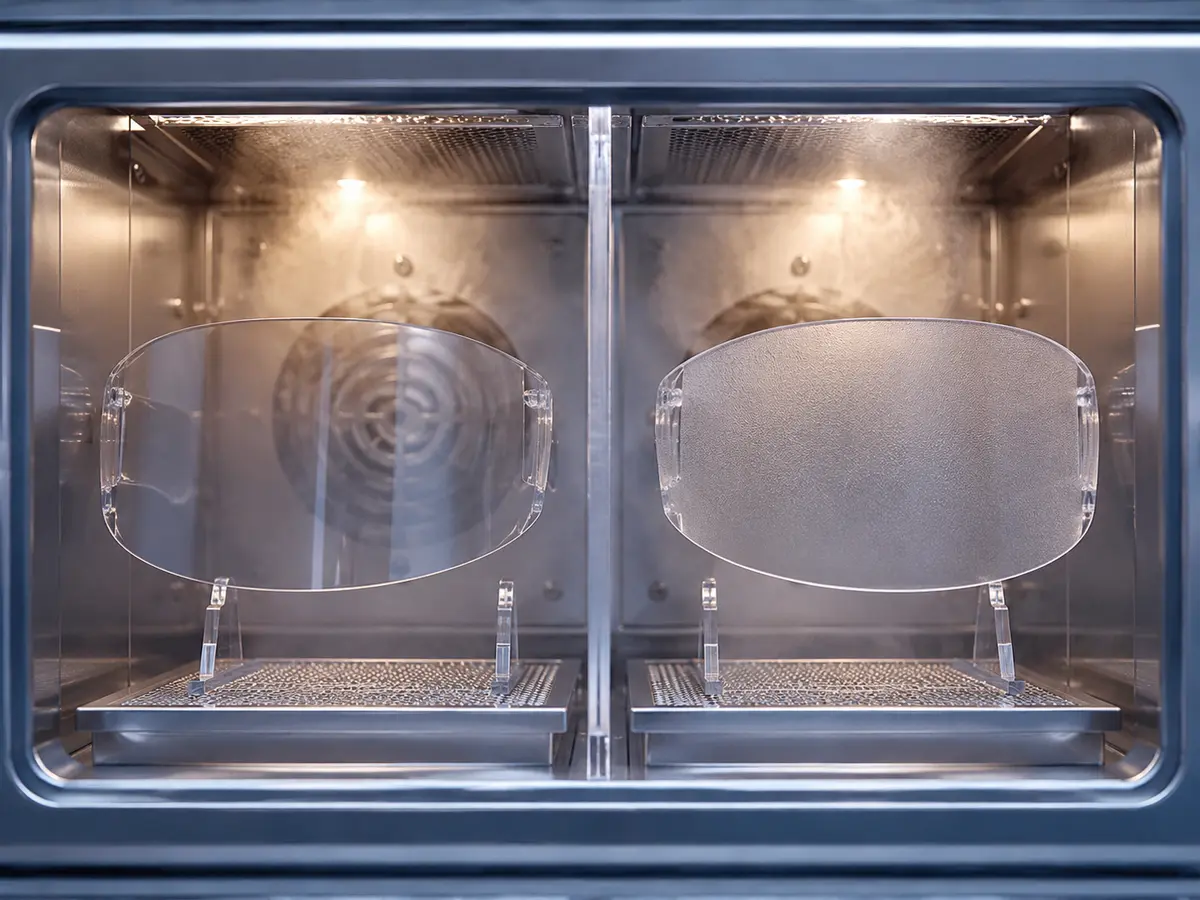
What the material stack contains.
Read the layers in functional order; the exact construction remains grade-specific.
- 01FC route: prepared unprimed PC / thermally cured anti-fog layer
- 02FT route: PC / qualified hardcoat / plasma activation / hydrophilic anti-fog topcoat
- 03Application-specific edge, ink and masking zones
Hydrophilic control of condensation at the optical surface.
01Fog reduces visibility when condensed water forms many discrete droplets that scatter light. A hydrophilic anti-fog surface encourages the moisture to spread into a more continuous film, reducing droplet-driven scattering.
02Anti-fog is not one universal formulation. FC-100 is positioned for qualified unprimed polycarbonate, while FT-100 uses a different route for a plasma-activated hardcoated PC surface. Mixing the preparation routes can cause immediate or aged adhesion failure.
03Initial clarity is only the first screen. Cleaning, abrasion, skin oils, packaging contact, humidity cycling and time between plasma treatment and coating can determine whether anti-fog performance survives real use.
Performance framed around the application.
Benefits are evaluated on the intended substrate, process and finished assembly.
Hydrophilic fog-management mechanism
Routes for both qualified unprimed PC and hardcoated PC
Designed for safety eyewear, shields and visor applications
Application support covering pretreatment, coating and cure
From material definition to a qualified production stack.
Qualification links the material, converting route and customer production line.
Determine whether the PC is bare, primed, hardcoated, printed or metallized.
Use the approved FC or FT preparation and activation sequence.
Control wet film, drainage, edge zones, flash-off and thermal cure.
Run the agreed fog, cleaning, abrasion and conditioning sequence.
Evidence to collect before specification release.
Use representative substrates, process conditions and aging sequences.
- Defined hot-fog, cold-to-warm or customer-specific condensation test
- Optical transmission and haze before, during and after conditioning
- Adhesion to bare or activated hardcoated PC
- Cleaning-agent, sweat, abrasion and packaging-contact durability
- Appearance uniformity around edges, holes, masks and printed zones
Values require a method and an approved revision.
Typical values support selection; controlled specifications come from the approved TDS.
Typical values are not specifications. Final limits are subject to the approved ECLEAR TDS and customer validation.
Questions engineers ask before a line trial.
Resolve the material role, interfaces and process window before sampling.
Does an anti-fog coating repel water?+
Normally no. Hydrophilic anti-fog technology spreads condensed water; hydrophobic technology promotes beading and roll-off. They solve different moisture problems and must not be described as interchangeable.
Can FT-100 be coated directly on any hardcoat?+
No. The hardcoat chemistry, plasma energy, surface cleanliness and treatment-to-coating time must be validated as a system.
Can ECLEAR recommend a grade from an application description alone?+
A first shortlist is possible, but a production recommendation requires the substrate, layer construction, equipment, process sequence, test method and acceptance criteria. ECLEAR normally moves from requirement definition to laboratory matching, samples, line trial and a frozen approved specification.
Are the values shown on this page guaranteed specifications?+
No. Website values and constructions are selection guidance. Guaranteed limits, test conditions, packaging and shelf life are controlled only by the latest ECLEAR-approved TDS, quality agreement and customer qualification record.
Where this platform is evaluated.
Each application still requires stack-level compatibility and line validation.
Parameters to control.
Record the complete process window, not only one nominal setting.
- Do not substitute the FC and FT preparation routes.
- For FT-100, validate hardcoat chemistry, plasma energy, treatment-to-coating time and surface cleanliness.
- Control wet-film uniformity, flash-off, cure and handling after cure.
- Use the customer-agreed fog test, conditioning and abrasion sequence.
What we need to know.
These inputs allow ECLEAR to narrow the grade and validation plan.
- Q1Is the PC surface uncoated, primed, hardcoated, printed or metallized?
- Q2Is plasma treatment available and how is it controlled?
- Q3Which anti-fog standard and durability sequence must be met?
- Q4Will the coated surface contact cleaners, skin oils or packaging materials?
What a disciplined trial should expose early.
Early failure checks reduce scale-up risk and prevent false material comparisons.
Coating a hardcoat without the required activation step
Using an unspecified cleaner that changes hydrophilic performance
Blocking, print transfer or contamination during packaging
Treating one anti-fog grade description as a universal specification
Controlled technical documents.
Request the current revision for the selected ECLEAR grade and application.
Typical constructions and application concepts are provided for material selection only. Availability, structure, performance and process conditions are grade-specific and subject to the latest ECLEAR-approved TDS, application testing and final customer qualification.
Related material systems.
Review adjacent materials that interact with this product in the same stack or process.
Validate the complete stack, not one isolated material.
Share the substrate, construction, process and acceptance criteria for a focused recommendation.