 ®
®EC-CO-AR-D115
1.15Reported n at 550 nm
Low-index coating candidate · n 1.15
Reported haze is 0.02% at approximately 1 μm film thickness. Confirm optical performance at the intended application thickness.
Request a Technical Review ↗ECLEAR presents two candidate liquid coatings for wet-process anti-reflection evaluation. Different reported cured-film refractive indices support material and layer-design studies on a compatible substrate and complete optical stack.
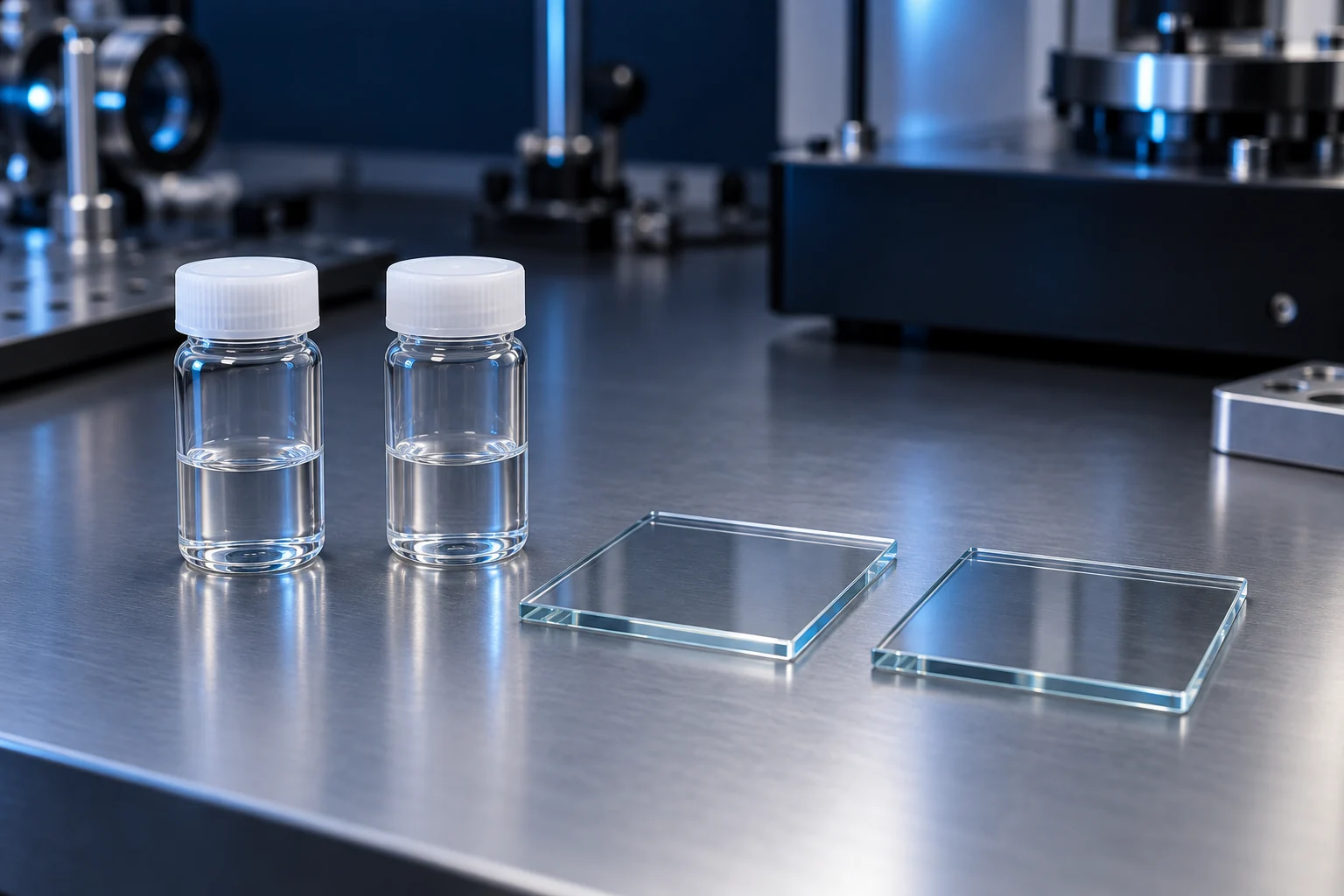
D115 and D125 are proposed ECLEAR development references for separate candidates, not released commercial grades. Suitability for a customer process requires validation.
Reported haze is 0.02% at approximately 1 μm film thickness. Confirm optical performance at the intended application thickness.
Request a Technical Review ↗Reported haze is 2.0% at approximately 1 μm film thickness. Optical clarity requires particular attention; this does not establish an anti-glare function.
Request a Technical Review ↗Source-reported sample data dated 09 September 2026. These values are not ECLEAR verification results or batch acceptance limits.
| Property / reported condition | EC-CO-AR-D115 | EC-CO-AR-D125 |
|---|---|---|
| Cured-film refractive index n · 550 nm | 1.15 | 1.25 |
| Viscosity | 2.0 cP | 2.5 cP |
| Solids content | 6.4% | 14% |
| Haze · approximately 1 μm film | 0.02% | 2.0% |
| Ellipsometry measurement-film thickness | 1.01 μm | 1.01 μm |
| Extinction coefficient k · 550 nm | 0.0000 | 0.0000 |
| Laboratory curing condition | 230°C × 30 min | 230°C × 30 min |
| Storage temperature | 4–10°C | 4–10°C |
| Storage duration | 3 months | 3 months |
A lower refractive index does not automatically mean lower reflection. No reflectance or absolute transmission specification is assigned. Neither candidate has a verified hardness, hydrophobic or anti-fingerprint specification.
Initial screening can consider glass or other substrates proven to tolerate the selected process. PET display films remain a development direction. Suitability for PET, PC, PMMA and existing hardcoats has not been established.
Share the substrate, existing coatings, wavelength range, intended dry-film thickness and target optical performance.
Review coating equipment and curing limits. Dilution, solvent, filtration, pot life and coating-speed windows are not validated in the available data.
Validate reflection, transmission, haze, adhesion and application-specific durability on the actual thickness and complete structure.
The English TDS covers both candidates, reported properties, process limitations and the scope of application evaluation.
Download preliminary TDS · English (Word) ↓Include the selected development reference, substrate, intended coating thickness, curing limits and durability requirements in your enquiry.
Request a Technical Review ↗