 ®
®ECLEAR Anti-Scratch Hard Coatings
Consulte os modelos ECLEAR, a construção do material, as aplicações, a janela de processo e os requisitos de validação desta família técnica.
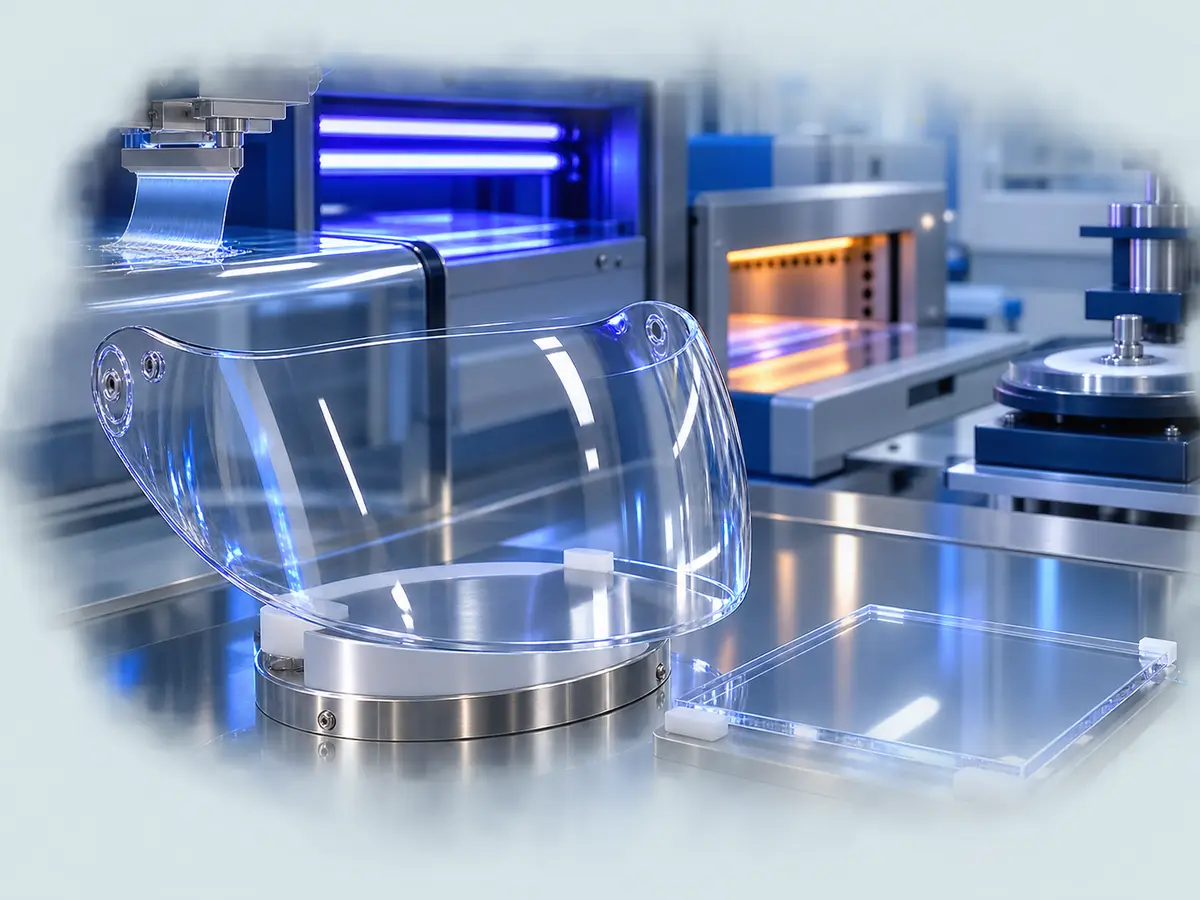
O que compõe a estrutura do material.
As camadas são apresentadas na ordem funcional; a construção exata depende do grau.
- 01Prepared polymer substrate
- 02ECLEAR adhesion and curing interface
- 03Crosslinked abrasion-resistant hardcoat
- 04Optional compatible anti-fog, hydrophobic or other functional topcoat
Graus identificados para seleção técnica.
Cada modelo ECLEAR representa uma função e uma construção distintas. As correspondências de fabricação permanecem controladas no cadastro mestre da ECLEAR para garantir rastreabilidade.
A crosslinked surface layer that protects transparent polymers.
01Uncoated thermoplastics are light and formable, but their surfaces can be vulnerable to scratching, chemicals and handling damage. A hardcoat adds a thin, optically clear network at the exposed surface while preserving the bulk properties of the molded part.
02Performance depends on more than coating chemistry. Substrate additives, residual molding stress, cleaning, wet-film uniformity, flash-off and cure history all affect adhesion and appearance. ECLEAR therefore treats the substrate, coating method and cure route as one controlled system.
03Heat-cured, UV-cured and dual-cure routes serve different geometries and manufacturing flows. Dual-cure concepts can provide a controlled pre-cure for handling or forming followed by final UV cure, but the exact sequence must be validated for the selected grade and part.
Desempenho definido em torno da aplicação.
Os benefícios são avaliados no substrato, no processo e no conjunto final pretendidos.
Improves scratch and abrasion resistance while maintaining optical clarity on qualified polymer substrates
Optically clear formulations for lenses, visors and molded optical parts
Heat, UV and dual-cure routes available within the wider platform
Supports flat and 3D parts made by injection molding, extrusion, casting or thermoforming
Da definição do material a uma estrutura de produção qualificada.
A qualificação conecta o material, a conversão e a linha de produção do cliente.
Confirm resin, additives, molding stress, geometry and downstream layers.
Define cleaning, activation and contamination controls for the real part.
Control application mass, leveling, flash-off and the approved thermal or UV profile.
Test adhesion, abrasion, optics, weathering and intercoat compatibility on production geometry.
Evidências a reunir antes da liberação da especificação.
Use substratos, condições de processo e sequências de envelhecimento representativos.
- Cross-hatch or customer-specified adhesion before and after conditioning
- Abrasion or scratch method with defined load, media and cycles
- Haze, transmittance, optical distortion and cosmetic inspection
- Humidity, thermal cycling, chemical exposure and weathering as required
- Compatibility with printing, PVD, anti-fog and easy-clean topcoats
Os valores exigem método e revisão aprovada.
Valores típicos orientam a seleção; os limites controlados vêm da TDS aprovada.
Valores típicos não são especificações. Os limites finais dependem da TDS ECLEAR aprovada e da validação do cliente.
Perguntas dos engenheiros antes do teste em linha.
Defina a função, as interfaces e a janela de processo antes da amostragem.
Can one hardcoat be used on every transparent plastic?+
No. PC, PMMA, PCTG, TAC, nylon, Tritan, PET-family materials and cast lens resins differ in surface chemistry, stress sensitivity and thermal limits. The exact substrate grade must be qualified.
Does a higher pencil-hardness number guarantee better field durability?+
Not by itself. Pencil hardness, abrasion, impact, adhesion, weathering and optical quality measure different failure modes. The test package should reflect the finished product.
Can ECLEAR recommend a grade from an application description alone?+
A first shortlist is possible, but a production recommendation requires the substrate, layer construction, equipment, process sequence, test method and acceptance criteria. ECLEAR normally moves from requirement definition to laboratory matching, samples, line trial and a frozen approved specification.
Are the values shown on this page guaranteed specifications?+
No. Website values and constructions are selection guidance. Guaranteed limits, test conditions, packaging and shelf life are controlled only by the latest ECLEAR-approved TDS, quality agreement and customer qualification record.
Onde esta plataforma é avaliada.
Cada aplicação ainda exige compatibilidade da estrutura completa e validação na linha.
Parâmetros a controlar.
Registre a janela completa do processo, não apenas um ajuste nominal.
- Confirm resin grade, molding history and residual stress before coating.
- Define cleaning, activation, coating method, flash-off, cure and post-cure as one controlled process.
- Validate optical distortion and adhesion on the final part geometry, not only a flat coupon.
- Test compatibility before applying inks, PVD layers, anti-fog or hydrophobic topcoats.
O que precisamos saber.
Essas informações permitem à ECLEAR restringir o grau e o plano de validação.
- Q1What is the exact substrate resin, supplier and molding condition?
- Q2Which coating method and production capacity are required?
- Q3What abrasion, adhesion, weathering and optical tests must be passed?
- Q4Will the surface receive printing, PVD, anti-fog, photochromic, anti-reflective or easy-clean treatment?
O que um teste disciplinado deve revelar cedo.
As verificações antecipadas reduzem o risco de escala e evitam comparações incorretas.
Residual stress cracking or solvent attack on an unverified substrate
Incomplete cure, intercoat incompatibility or adhesion loss
Flow marks, edge build-up or optical distortion on complex geometry
Over-generalizing a laboratory result to a customer production line
Documentos técnicos controlados.
Solicite a revisão atual para o grau ECLEAR e a aplicação selecionados.
As construções típicas e os conceitos de aplicação são fornecidos apenas para a seleção do material. Disponibilidade, estrutura, desempenho e condições de processo dependem do grau e estão sujeitos à TDS ECLEAR vigente, aos testes de aplicação e à qualificação final do cliente.
Sistemas de materiais relacionados.
Revise os materiais adjacentes que interagem com este produto na mesma estrutura ou processo.
Valide a estrutura completa, não um material isolado.
Compartilhe o substrato, a construção, o processo e os critérios de aceitação para uma recomendação objetiva.