 ®
®Rivestimenti antigraffio ECLEAR per plastiche ottiche
I gradi ECLEAR-V, S, IM, TT, PA e CR coprono sistemi hard coat termici, UV e dual-cure per substrati ottici polimerici qualificati.
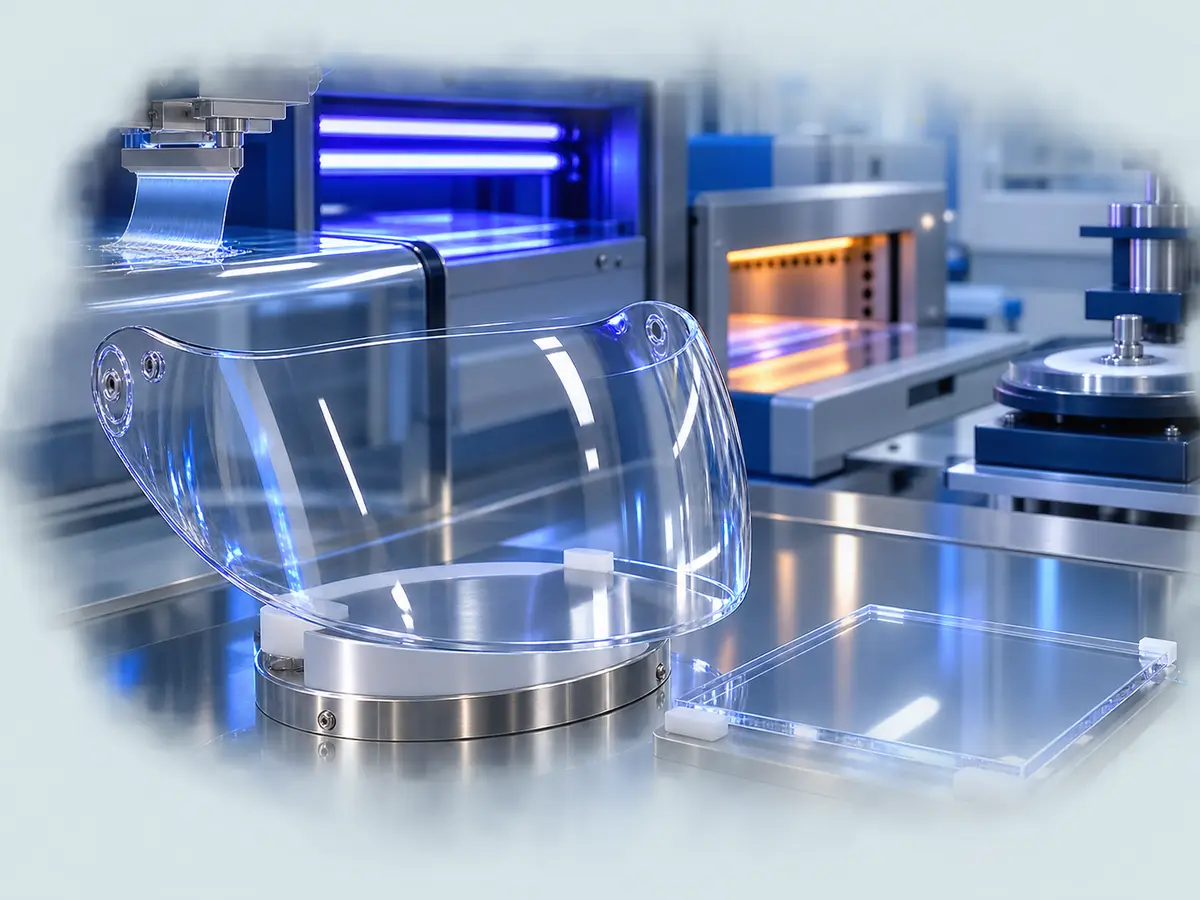
Che cosa contiene la struttura del materiale.
Gli strati sono mostrati in ordine funzionale; la struttura esatta dipende dal grado.
- 01Prepared polymer substrate
- 02ECLEAR adhesion and curing interface
- 03Crosslinked abrasion-resistant hardcoat
- 04Optional compatible anti-fog, hydrophobic or other functional topcoat
Gradi identificati per la selezione tecnica.
Ogni modello ECLEAR indica un ruolo e una struttura distinti. Le corrispondenze di produzione restano controllate nell’anagrafica prodotti ECLEAR per la tracciabilità.
A crosslinked surface layer that protects transparent polymers.
01Uncoated thermoplastics are light and formable, but their surfaces can be vulnerable to scratching, chemicals and handling damage. A hardcoat adds a thin, optically clear network at the exposed surface while preserving the bulk properties of the molded part.
02Performance depends on more than coating chemistry. Substrate additives, residual molding stress, cleaning, wet-film uniformity, flash-off and cure history all affect adhesion and appearance. ECLEAR therefore treats the substrate, coating method and cure route as one controlled system.
03Heat-cured, UV-cured and dual-cure routes serve different geometries and manufacturing flows. Dual-cure concepts can provide a controlled pre-cure for handling or forming followed by final UV cure, but the exact sequence must be validated for the selected grade and part.
Prestazioni definite in funzione dell’applicazione.
I vantaggi vengono valutati sul substrato, sul processo e sull’assieme finale previsti.
Improves scratch and abrasion resistance while maintaining optical clarity on qualified polymer substrates
Optically clear formulations for lenses, visors and molded optical parts
Heat, UV and dual-cure routes available within the wider platform
Supports flat and 3D parts made by injection molding, extrusion, casting or thermoforming
Dalla definizione del materiale a una struttura produttiva qualificata.
La qualifica collega materiale, trasformazione e linea produttiva del cliente.
Confirm resin, additives, molding stress, geometry and downstream layers.
Define cleaning, activation and contamination controls for the real part.
Control application mass, leveling, flash-off and the approved thermal or UV profile.
Test adhesion, abrasion, optics, weathering and intercoat compatibility on production geometry.
Evidenze da raccogliere prima del rilascio della specifica.
Utilizzare substrati, condizioni di processo e sequenze di invecchiamento rappresentativi.
- Cross-hatch or customer-specified adhesion before and after conditioning
- Abrasion or scratch method with defined load, media and cycles
- Haze, transmittance, optical distortion and cosmetic inspection
- Humidity, thermal cycling, chemical exposure and weathering as required
- Compatibility with printing, PVD, anti-fog and easy-clean topcoats
I valori richiedono un metodo e una revisione approvata.
I valori tipici guidano la selezione; i limiti controllati provengono dalla TDS approvata.
I valori tipici non sono specifiche. I limiti finali dipendono dalla TDS ECLEAR approvata e dalla validazione del cliente.
Domande degli ingegneri prima di una prova in linea.
Definire ruolo, interfacce e finestra di processo prima del campionamento.
Can one hardcoat be used on every transparent plastic?+
No. PC, PMMA, PCTG, TAC, nylon, Tritan, PET-family materials and cast lens resins differ in surface chemistry, stress sensitivity and thermal limits. The exact substrate grade must be qualified.
Does a higher pencil-hardness number guarantee better field durability?+
Not by itself. Pencil hardness, abrasion, impact, adhesion, weathering and optical quality measure different failure modes. The test package should reflect the finished product.
Can ECLEAR recommend a grade from an application description alone?+
A first shortlist is possible, but a production recommendation requires the substrate, layer construction, equipment, process sequence, test method and acceptance criteria. ECLEAR normally moves from requirement definition to laboratory matching, samples, line trial and a frozen approved specification.
Are the values shown on this page guaranteed specifications?+
No. Website values and constructions are selection guidance. Guaranteed limits, test conditions, packaging and shelf life are controlled only by the latest ECLEAR-approved TDS, quality agreement and customer qualification record.
Dove viene valutata questa piattaforma.
Ogni applicazione richiede comunque compatibilità dell’intera struttura e validazione in linea.
Parametri da controllare.
Registrare l’intera finestra di processo, non un solo valore nominale.
- Confirm resin grade, molding history and residual stress before coating.
- Define cleaning, activation, coating method, flash-off, cure and post-cure as one controlled process.
- Validate optical distortion and adhesion on the final part geometry, not only a flat coupon.
- Test compatibility before applying inks, PVD layers, anti-fog or hydrophobic topcoats.
Che cosa dobbiamo sapere.
Questi dati consentono a ECLEAR di restringere il grado e il piano di validazione.
- Q1What is the exact substrate resin, supplier and molding condition?
- Q2Which coating method and production capacity are required?
- Q3What abrasion, adhesion, weathering and optical tests must be passed?
- Q4Will the surface receive printing, PVD, anti-fog, photochromic, anti-reflective or easy-clean treatment?
Che cosa deve rivelare subito una prova rigorosa.
I controlli precoci riducono il rischio di scala e i confronti errati tra materiali.
Residual stress cracking or solvent attack on an unverified substrate
Incomplete cure, intercoat incompatibility or adhesion loss
Flow marks, edge build-up or optical distortion on complex geometry
Over-generalizing a laboratory result to a customer production line
Documenti tecnici controllati.
Richiedere la revisione corrente per il grado ECLEAR e l’applicazione selezionati.
Le strutture tipiche e i concetti applicativi sono forniti esclusivamente per la selezione del materiale. Disponibilità, struttura, prestazioni e condizioni di processo dipendono dal grado e sono soggette alla TDS ECLEAR approvata più recente, alle prove applicative e alla qualifica finale del cliente.
Sistemi di materiali correlati.
Esaminare i materiali adiacenti che interagiscono con questo prodotto nella stessa struttura o nello stesso processo.
Convalidare l’intera struttura, non un singolo materiale.
Condividere substrato, struttura, processo e criteri di accettazione per una raccomandazione mirata.