 ®
®Rivestimenti idrofobici e oleofobici easy-clean
I topcoat ECLEAR riducono l’energia superficiale per favorire il gocciolamento dell’acqua e agevolare la pulizia delle superfici ottiche qualificate.
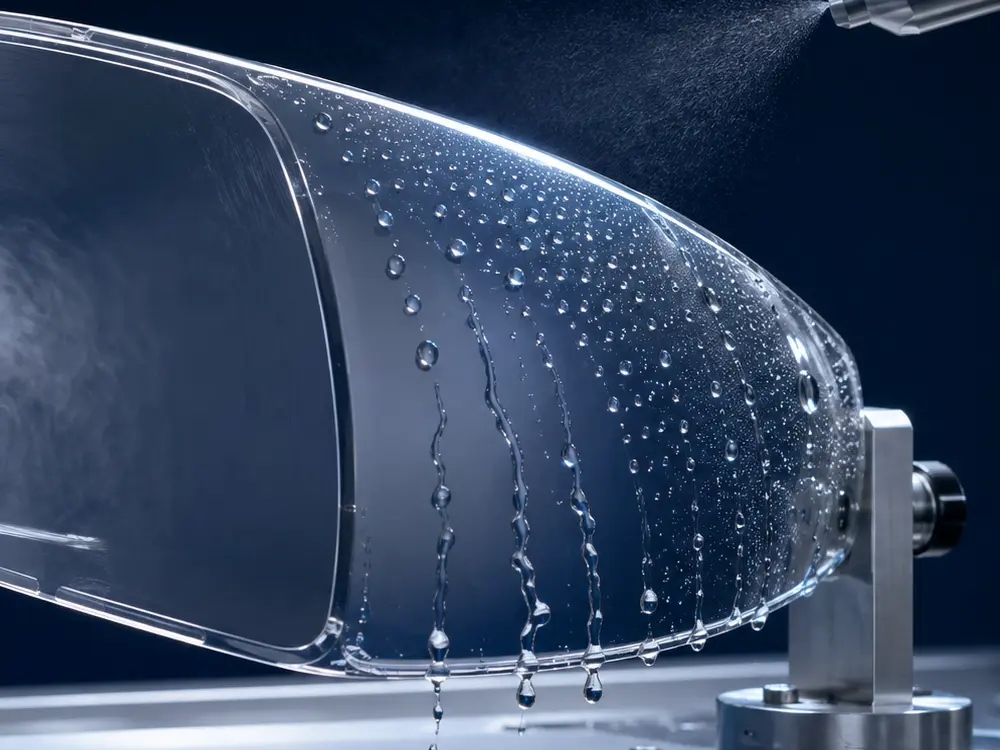
Che cosa contiene la struttura del materiale.
Gli strati sono mostrati in ordine funzionale; la struttura esatta dipende dal grado.
- 01Qualified substrate or hardcoat
- 02Optional activation/primer interface
- 03Thin hydrophobic or oleophobic topcoat
Lower surface energy for water beading and easier cleaning.
01A hydrophobic topcoat changes the interaction between the exposed surface and water. Instead of spreading, a droplet forms a higher contact angle and can roll away more readily when gravity, airflow or wiping force is applied.
02Oleophobic and easy-clean performance are related but not identical to water repellency. Oils, fingerprints and cleaning agents have different surface tensions, so each target should be measured with an appropriate liquid, method and durability sequence.
03The topcoat is thin and interface-sensitive. Contamination, incomplete activation, excessive coating mass or incompatibility with a hardcoat, PVD film or ink can reduce adhesion or create optical non-uniformity.
Prestazioni definite in funzione dell’applicazione.
I vantaggi vengono valutati sul substrato, sul processo e sull’assieme finale previsti.
Water beading and roll-off
Reduced adhesion of fingerprints, smudges and grime
Easier cleaning on qualified surfaces
Integration support for hardcoat and metallized stacks
Dalla definizione del materiale a una struttura produttiva qualificata.
La qualifica collega materiale, trasformazione e linea produttiva del cliente.
Identify hardcoat, metalized surface, polymer or glass and its cleaning history.
Control surface energy, activation and time before coating.
Stabilize coating mass, uniformity and the approved cure route.
Measure water, oil and easy-clean behavior after relevant wear and chemicals.
Evidenze da raccogliere prima del rilascio della specifica.
Utilizzare substrati, condizioni di processo e sequenze di invecchiamento rappresentativi.
- Static or dynamic water-contact angle using a defined droplet volume
- Roll-off or sliding-angle test on the intended part orientation
- Fingerprint, oil and cleaning evaluation with controlled materials
- Abrasion and chemical durability of retained easy-clean performance
- Optical appearance and intercoat adhesion on the finished stack
I valori richiedono un metodo e una revisione approvata.
I valori tipici guidano la selezione; i limiti controllati provengono dalla TDS approvata.
I valori tipici non sono specifiche. I limiti finali dipendono dalla TDS ECLEAR approvata e dalla validazione del cliente.
Domande degli ingegneri prima di una prova in linea.
Definire ruolo, interfacce e finestra di processo prima del campionamento.
Is contact angle alone enough to select an easy-clean coating?+
No. Contact angle is useful, but roll-off, hysteresis, oil interaction, abrasion durability and compatibility with the underlying stack are also important.
Can the coating be used on both polymer and glass?+
The public platform includes qualified hardcoated or metallized PC and acrylic surfaces, with other polymers and glass evaluated project by project.
Can ECLEAR recommend a grade from an application description alone?+
A first shortlist is possible, but a production recommendation requires the substrate, layer construction, equipment, process sequence, test method and acceptance criteria. ECLEAR normally moves from requirement definition to laboratory matching, samples, line trial and a frozen approved specification.
Are the values shown on this page guaranteed specifications?+
No. Website values and constructions are selection guidance. Guaranteed limits, test conditions, packaging and shelf life are controlled only by the latest ECLEAR-approved TDS, quality agreement and customer qualification record.
Dove viene valutata questa piattaforma.
Ogni applicazione richiede comunque compatibilità dell’intera struttura e validazione in linea.
Parametri da controllare.
Registrare l’intera finestra di processo, non un solo valore nominale.
- Validate cleanliness and surface energy immediately before application.
- Control coating mass, uniformity and cure according to the approved grade.
- Measure initial and aged easy-clean performance after the relevant abrasion and chemical cycles.
- Confirm compatibility with adjacent anti-fog, AR, PVD and ink layers.
Che cosa dobbiamo sapere.
Questi dati consentono a ECLEAR di restringere il grado e il piano di validazione.
- Q1What is the exposed surface chemistry?
- Q2Is the priority water repellency, oil repellency, easy cleaning or all three?
- Q3Which cleaners and abrasion cycles represent real use?
- Q4What optical and appearance limits apply?
Che cosa deve rivelare subito una prova rigorosa.
I controlli precoci riducono il rischio di scala e i confronti errati tra materiali.
Poor adhesion on a contaminated or low-energy surface
Loss of performance after an unrepresentative abrasion test
Optical non-uniformity from excessive coating mass
Incompatibility with PVD, ink or another functional layer
Documenti tecnici controllati.
Richiedere la revisione corrente per il grado ECLEAR e l’applicazione selezionati.
Le strutture tipiche e i concetti applicativi sono forniti esclusivamente per la selezione del materiale. Disponibilità, struttura, prestazioni e condizioni di processo dipendono dal grado e sono soggette alla TDS ECLEAR approvata più recente, alle prove applicative e alla qualifica finale del cliente.
Sistemi di materiali correlati.
Esaminare i materiali adiacenti che interagiscono con questo prodotto nella stessa struttura o nello stesso processo.
Convalidare l’intera struttura, non un singolo materiale.
Condividere substrato, struttura, processo e criteri di accettazione per una raccomandazione mirata.