 ®
®Revêtements anti-rayures ECLEAR pour plastiques optiques
Les grades ECLEAR-V, S, IM, TT, PA et CR couvrent des hard coats thermiques, UV ou dual-cure pour des substrats optiques polymères qualifiés.
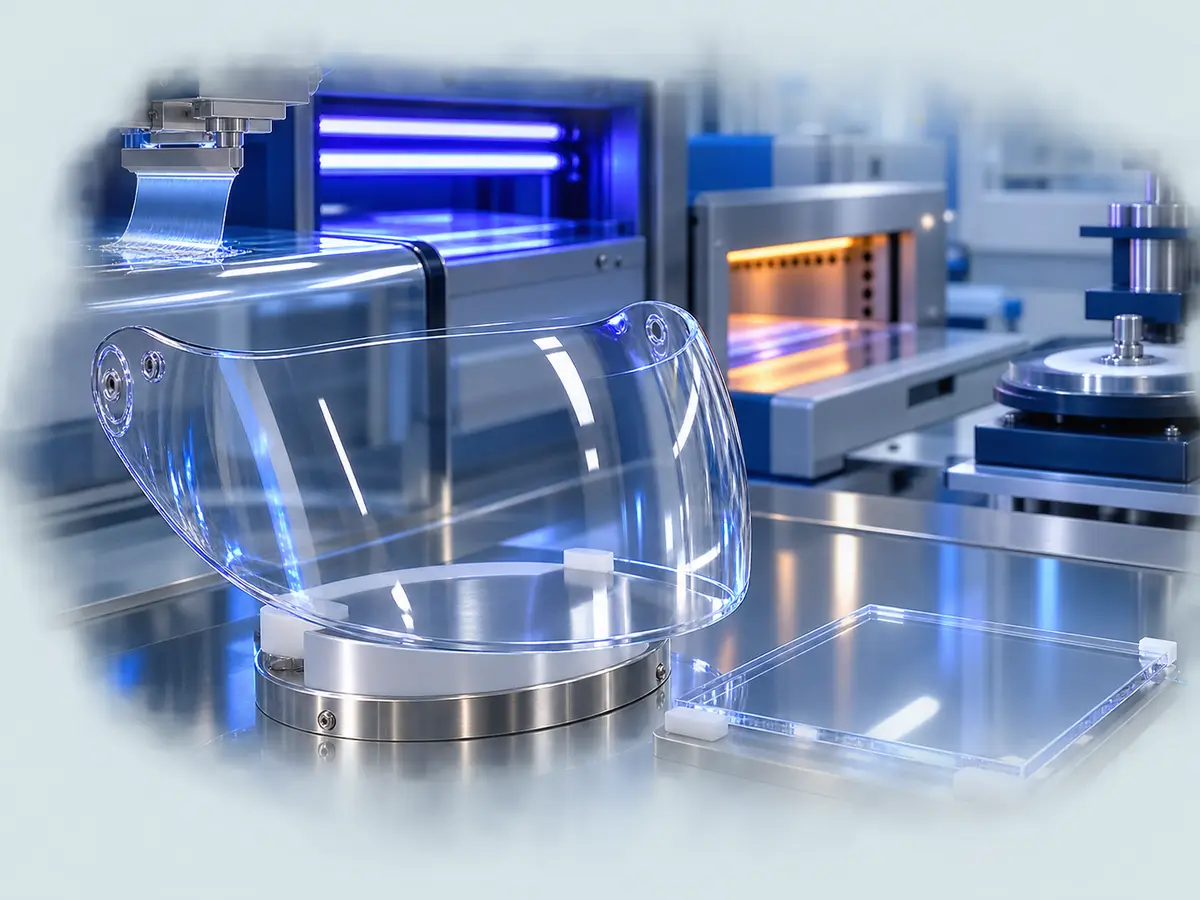
Ce que contient l’empilement du matériau.
Les couches sont présentées dans l’ordre fonctionnel ; la construction exacte dépend du grade.
- 01Prepared polymer substrate
- 02ECLEAR adhesion and curing interface
- 03Crosslinked abrasion-resistant hardcoat
- 04Optional compatible anti-fog, hydrophobic or other functional topcoat
Grades identifiés pour la sélection technique.
Chaque modèle ECLEAR correspond à un rôle et à une construction distincts. Les correspondances de fabrication restent maîtrisées dans le référentiel produit ECLEAR pour assurer la traçabilité.
A crosslinked surface layer that protects transparent polymers.
01Uncoated thermoplastics are light and formable, but their surfaces can be vulnerable to scratching, chemicals and handling damage. A hardcoat adds a thin, optically clear network at the exposed surface while preserving the bulk properties of the molded part.
02Performance depends on more than coating chemistry. Substrate additives, residual molding stress, cleaning, wet-film uniformity, flash-off and cure history all affect adhesion and appearance. ECLEAR therefore treats the substrate, coating method and cure route as one controlled system.
03Heat-cured, UV-cured and dual-cure routes serve different geometries and manufacturing flows. Dual-cure concepts can provide a controlled pre-cure for handling or forming followed by final UV cure, but the exact sequence must be validated for the selected grade and part.
Des performances définies autour de l’application.
Les avantages sont évalués sur le substrat, le procédé et l’assemblage final visés.
Improves scratch and abrasion resistance while maintaining optical clarity on qualified polymer substrates
Optically clear formulations for lenses, visors and molded optical parts
Heat, UV and dual-cure routes available within the wider platform
Supports flat and 3D parts made by injection molding, extrusion, casting or thermoforming
De la définition du matériau à un empilement de production qualifié.
La qualification relie le matériau, la transformation et la ligne de production du client.
Confirm resin, additives, molding stress, geometry and downstream layers.
Define cleaning, activation and contamination controls for the real part.
Control application mass, leveling, flash-off and the approved thermal or UV profile.
Test adhesion, abrasion, optics, weathering and intercoat compatibility on production geometry.
Les preuves à réunir avant de libérer la spécification.
Utilisez des substrats, des conditions de procédé et des séquences de vieillissement représentatifs.
- Cross-hatch or customer-specified adhesion before and after conditioning
- Abrasion or scratch method with defined load, media and cycles
- Haze, transmittance, optical distortion and cosmetic inspection
- Humidity, thermal cycling, chemical exposure and weathering as required
- Compatibility with printing, PVD, anti-fog and easy-clean topcoats
Toute valeur exige une méthode et une révision approuvée.
Les valeurs types orientent la sélection ; les limites maîtrisées proviennent de la TDS approuvée.
Les valeurs types ne constituent pas des spécifications. Les limites finales dépendent de la TDS ECLEAR approuvée et de la validation client.
Les questions des ingénieurs avant un essai en ligne.
Clarifiez le rôle du matériau, les interfaces et la fenêtre de procédé avant l’échantillonnage.
Can one hardcoat be used on every transparent plastic?+
No. PC, PMMA, PCTG, TAC, nylon, Tritan, PET-family materials and cast lens resins differ in surface chemistry, stress sensitivity and thermal limits. The exact substrate grade must be qualified.
Does a higher pencil-hardness number guarantee better field durability?+
Not by itself. Pencil hardness, abrasion, impact, adhesion, weathering and optical quality measure different failure modes. The test package should reflect the finished product.
Can ECLEAR recommend a grade from an application description alone?+
A first shortlist is possible, but a production recommendation requires the substrate, layer construction, equipment, process sequence, test method and acceptance criteria. ECLEAR normally moves from requirement definition to laboratory matching, samples, line trial and a frozen approved specification.
Are the values shown on this page guaranteed specifications?+
No. Website values and constructions are selection guidance. Guaranteed limits, test conditions, packaging and shelf life are controlled only by the latest ECLEAR-approved TDS, quality agreement and customer qualification record.
Domaines dans lesquels cette plateforme est évaluée.
Chaque application exige encore la compatibilité de l’empilement complet et la validation en ligne.
Paramètres à maîtriser.
Consignez la fenêtre de procédé complète, et non un seul réglage nominal.
- Confirm resin grade, molding history and residual stress before coating.
- Define cleaning, activation, coating method, flash-off, cure and post-cure as one controlled process.
- Validate optical distortion and adhesion on the final part geometry, not only a flat coupon.
- Test compatibility before applying inks, PVD layers, anti-fog or hydrophobic topcoats.
Les informations dont nous avons besoin.
Ces données permettent à ECLEAR de cibler le grade et le plan de validation.
- Q1What is the exact substrate resin, supplier and molding condition?
- Q2Which coating method and production capacity are required?
- Q3What abrasion, adhesion, weathering and optical tests must be passed?
- Q4Will the surface receive printing, PVD, anti-fog, photochromic, anti-reflective or easy-clean treatment?
Ce qu’un essai rigoureux doit révéler rapidement.
Les contrôles précoces réduisent les risques de mise à l’échelle et les comparaisons erronées.
Residual stress cracking or solvent attack on an unverified substrate
Incomplete cure, intercoat incompatibility or adhesion loss
Flow marks, edge build-up or optical distortion on complex geometry
Over-generalizing a laboratory result to a customer production line
Documents techniques maîtrisés.
Demandez la révision en vigueur pour le grade ECLEAR et l’application sélectionnés.
Les constructions types et les concepts d’application sont fournis uniquement pour la sélection du matériau. La disponibilité, la structure, les performances et les conditions de procédé dépendent du grade et restent soumises à la dernière TDS approuvée par ECLEAR, aux essais d’application et à la qualification finale du client.
Systèmes de matériaux associés.
Examinez les matériaux adjacents qui interagissent avec ce produit dans le même empilement ou procédé.
Validez l’empilement complet, pas un matériau isolé.
Communiquez le substrat, la construction, le procédé et les critères d’acceptation pour une recommandation ciblée.