 ®
®UV- und thermisch ablösbare Folien sowie Folien für Nacharbeit
UV- und thermisch ablösbare Folien zur temporären Prozessfixierung sowie durch Dehnung, Alkohol oder Wärme lösbare Klebebänder für Verklebungen während der Nutzungsdauer und für Reparaturen. Wählen Sie nach Substrat, Haltelast, Ablöseverfahren und Zeitpunkt der Entfernung.
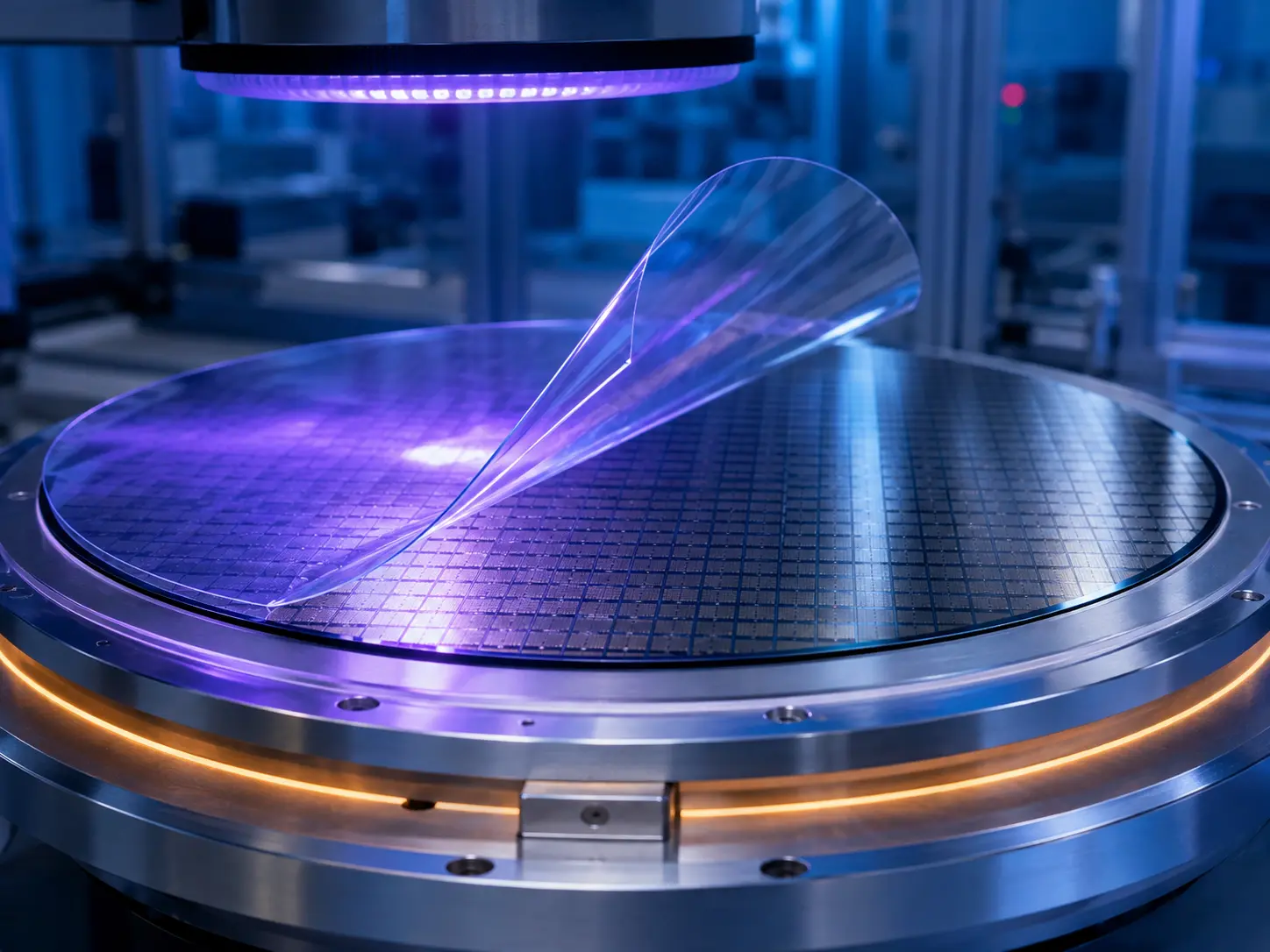
Bestandteile des Materialaufbaus.
Die Schichten sind in Funktionsreihenfolge dargestellt; der genaue Aufbau ist variantenspezifisch.
- 01PET, PO, TPU, carrierless or foam support selected for stiffness and conformity
- 02UV-responsive, heat-expandable, thermal-release, stretch-release or alcohol-release adhesive
- 03Optional PET or paper release liner
- 04Activation and removal step controlled in the customer process flow
Benannte Varianten für die technische Auswahl.
Jedes ECLEAR-Modell steht für eine eigene Materialfunktion und Konstruktion. Fertigungszuordnungen werden zur Rückverfolgbarkeit im ECLEAR-Produktstamm kontrolliert geführt.
Controlled release for process handling and repairable assemblies.
01UV-debonding films retain parts during cutting or handling, then reduce adhesion after a defined ultraviolet spectrum and dose. Substrate transmission, shadow zones, lamp aging and dose uniformity can create different release behavior across the same part.
02Thermal-release films use a grade-specific temperature and dwell to trigger clean separation. Heating rate, actual interface temperature, pressure and part thermal mass must be controlled rather than relying only on an oven set point.
03A successful debonding film balances holding power with removability. Repairable assembly tapes must maintain the required bond throughout service before the specified rework event. Residue, part movement, edge lift and substrate damage are evaluated before and after storage and process exposure.
Leistung im Kontext der Anwendung.
Vorteile werden auf dem vorgesehenen Substrat, im Prozess und in der Endbaugruppe bewertet.
Named UV-release grades across multiple carrier thicknesses and tack levels
Lined and linerless thermal-release films for different handling routes
Reworkable PET and foam tapes for electronics assembly
Clear separation of activation mechanism, temperature, dose and removal role
Von der Materialdefinition zum qualifizierten Produktionsaufbau.
Die Qualifizierung verbindet Material, Verarbeitung und Kundenproduktionslinie.
Record substrate, process force, dwell, temperature and required dimensional stability.
Match UV spectrum/dose or thermal profile to the part and equipment.
Measure shadow, edge, overlap and local-temperature conditions across the assembly.
Check peel force, residue, damage and throughput after realistic aging.
Nachweise vor der Freigabe der Spezifikation.
Verwenden Sie repräsentative Substrate, Prozessbedingungen und Alterungsfolgen.
- Pre-activation adhesion and shear stability through the full process
- Post-activation peel using a defined UV dose or thermal profile
- Shadow-zone, edge and overlap release uniformity
- Residue, outgassing, contamination and substrate-damage inspection
- Aged release after transport, storage and environmental exposure
Werte benötigen eine Methode und einen freigegebenen Revisionsstand.
Typische Werte unterstützen die Auswahl; kontrollierte Grenzen stammen aus der freigegebenen TDS.
Typische Werte sind keine Spezifikationen. Endgültige Grenzwerte unterliegen dem freigegebenen ECLEAR-TDS und der Kundenvalidierung.
Fragen der Ingenieure vor einem Linienversuch.
Klären Sie Materialfunktion, Grenzflächen und Prozessfenster vor der Bemusterung.
Is total UV dose enough to define debonding?+
No. Spectrum, irradiance, exposure time, lamp distance, substrate transmission and shadow geometry all influence the reaction. They must be recorded with the dose.
Can a thermal-release grade be selected from temperature alone?+
No. The actual interface temperature, dwell, pressure, heating rate, substrate and removal timing are part of the qualification window.
Can ECLEAR recommend a grade from an application description alone?+
A first shortlist is possible, but a production recommendation requires the substrate, layer construction, equipment, process sequence, test method and acceptance criteria. ECLEAR normally moves from requirement definition to laboratory matching, samples, line trial and a frozen approved specification.
Are the values shown on this page guaranteed specifications?+
No. Website values and constructions are selection guidance. Guaranteed limits, test conditions, packaging and shelf life are controlled only by the latest ECLEAR-approved TDS, quality agreement and customer qualification record.
Anwendungsfelder dieser Plattform.
Jede Anwendung erfordert weiterhin die Kompatibilität des Gesamtaufbaus und eine Linienvalidierung.
Zu kontrollierende Parameter.
Dokumentieren Sie das vollständige Prozessfenster und nicht nur einen Nennwert.
- Define the exact activation source, dose or time-temperature profile.
- Measure shaded edges, masked zones and heat-sink areas for incomplete release.
- Control lamination pressure, dwell, carrier strain and stripping geometry.
- Verify residue, part distortion and post-release surface cleanliness.
Welche Angaben wir benötigen.
Mit diesen Daten kann ECLEAR die Variante und den Validierungsplan eingrenzen.
- Q1What initial holding force is needed before activation?
- Q2Which UV wavelength/dose or thermal cycle is available on the line?
- Q3Is the substrate flat, curved, porous, fragile or temperature-sensitive?
- Q4Must the adhesive release once, reversibly or by mechanical stretch?
Was ein disziplinierter Versuch frühzeitig aufdecken sollte.
Frühe Fehlerprüfungen reduzieren Skalierungsrisiken und falsche Materialvergleiche.
Incomplete UV exposure in shadow zones
Thermal damage or distortion outside the substrate window
Residue after excessive dwell or unapproved aging
Confusing a reversible repair tape with an irreversible drop-off film
Kontrollierte technische Dokumente.
Fordern Sie den aktuellen Stand für die gewählte ECLEAR-Variante und Anwendung an.
Typische Aufbauten und Anwendungskonzepte dienen ausschließlich der Materialauswahl. Verfügbarkeit, Aufbau, Leistung und Prozessbedingungen sind variantenspezifisch und unterliegen der neuesten freigegebenen ECLEAR-TDS, den Anwendungstests und der abschließenden Kundenqualifizierung.
Verwandte Materialsysteme.
Prüfen Sie angrenzende Materialien, die im selben Aufbau oder Prozess mit diesem Produkt zusammenwirken.
Validieren Sie den Gesamtaufbau, nicht nur ein einzelnes Material.
Teilen Sie Substrat, Aufbau, Prozess und Abnahmekriterien für eine gezielte Empfehlung mit.