 ®
®Materiały do baterii EV i procesów półprzewodnikowych
ECLEAR klasyfikuje folie izolacyjne i ogniochronne EV, taśmy do wafli oraz folie trwałe według roli, aktywacji i planu kwalifikacji.
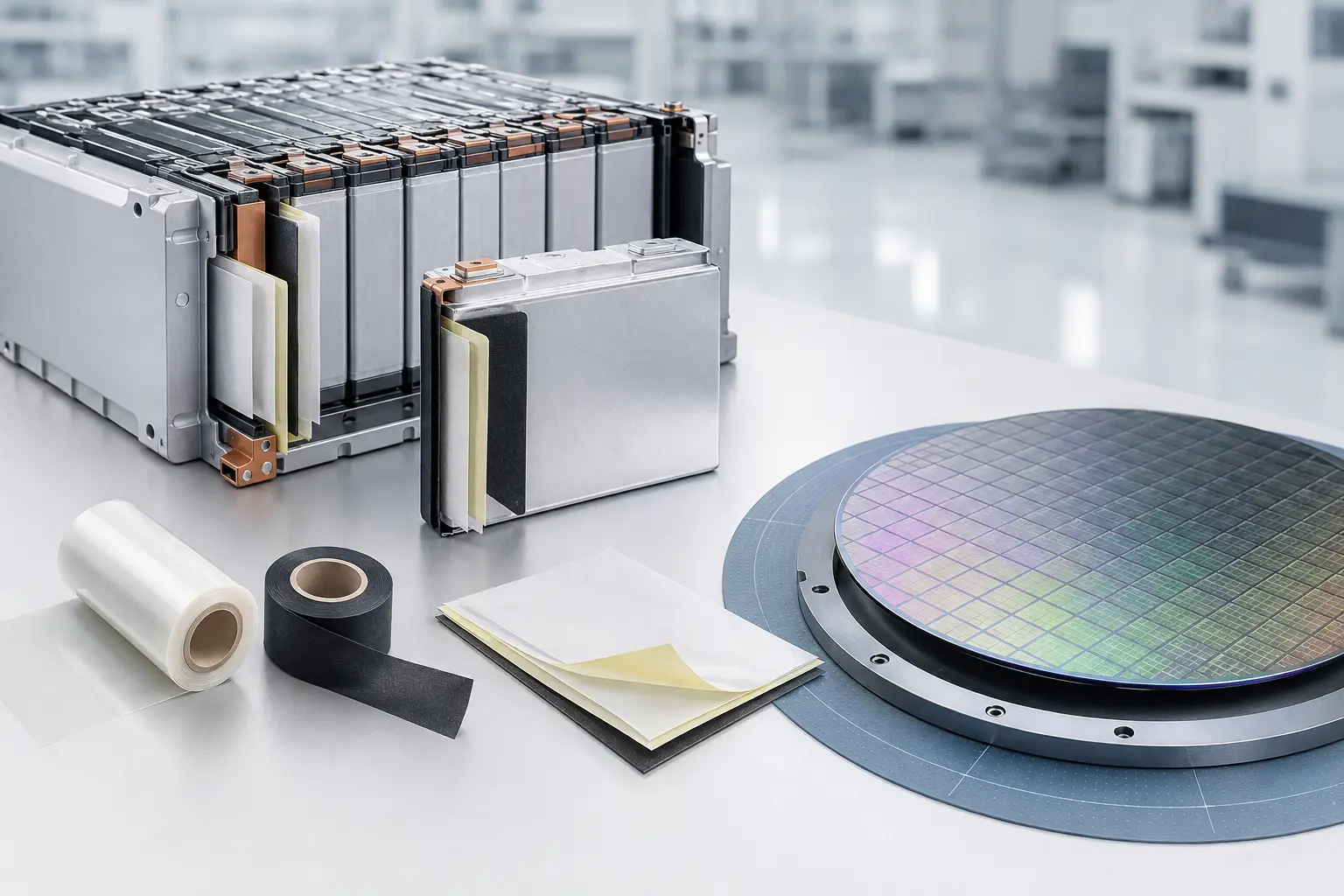
Elementy konstrukcji warstwowej materiału.
Warstwy pokazano w kolejności funkcjonalnej; dokładna konstrukcja zależy od wariantu.
- 01EV: application-specific insulation, flame-retardant, electrode and termination tapes/films
- 02Fuel cell: release liner / silicone adhesive / PEN film
- 03Semiconductor temporary tapes: carrier / responsive PSA / liner by process
- 04Permanent die-attach film: controlled adhesive stack; other thermal-process films: function and removal step require confirmation
Nazwane warianty do doboru technicznego.
Każdy model ECLEAR oznacza odrębną rolę materiału i konstrukcję. Odpowiedniki produkcyjne są kontrolowane w kartotece produktów ECLEAR dla zapewnienia identyfikowalności.
Material role must remain explicit across energy and wafer processes.
01EV materials may remain permanently as electrical insulation, flame-control support, fixation, cushioning or structural bonding. Semiconductor materials can be temporary process tapes for grinding, de-taping, dicing and singulation, or permanent films such as selected die-attach materials.
02The same words—film, tape or release—can refer to very different lifecycle roles. Each drawing and process flow must state whether the material remains in the product, how it is activated and at which step it is removed.
03Electrical, thermal, chemical and mechanical performance are stack-level properties. Flame, dielectric, electrolyte, UV-release and wafer-pick claims require a defined standard, thickness, process and final-customer qualification.
Wydajność oceniana w kontekście zastosowania.
Korzyści ocenia się na docelowym podłożu, w procesie i w gotowym zespole.
Clear separation of temporary process films and permanent functional layers
Material families for cell, module, CCS and pack-level needs
Thin PEN-based fuel-cell insulation/fixation option
Process-tape coverage from wafer thinning through package singulation
Od definicji materiału do zakwalifikowanej konstrukcji produkcyjnej.
Kwalifikacja łączy materiał, sposób przetwarzania i linię produkcyjną klienta.
Permanent insulation/bonding or temporary process support and its removal step.
Set voltage, heat, chemicals, compression, wafer process and activation route.
Freeze thickness, coverage, edge design, dose/heat and equipment settings.
Test electrical, thermal, release, cleanliness and package reliability.
Dowody wymagane przed zatwierdzeniem specyfikacji.
Należy użyć reprezentatywnych podłoży, warunków procesu i sekwencji starzenia.
- Dielectric, insulation and edge-coverage evaluation in the EV assembly
- Thermal, flame and chemical testing to the named standard and thickness
- UV or thermal release including shadow, edge and aged conditions
- Wafer breakage, die fly, pick force, residue, low-k and ESD checks
- DAF bondline, void, warpage, cure and package reliability where applicable
Każda wartość wymaga metody i zatwierdzonej rewizji.
Wartości typowe wspierają dobór; kontrolowane limity pochodzą z zatwierdzonej TDS.
Wartości typowe nie są specyfikacją. Ostateczne limity wynikają z zatwierdzonej karty TDS ECLEAR i walidacji klienta.
Pytania inżynierów przed próbą na linii.
Przed pobraniem próbek określ rolę materiału, interfejsy i okno procesu.
How are EV and semiconductor material grades specified?+
ECLEAR publishes the applicable family and named grade where the construction is defined. The current controlled TDS then governs thickness, adhesive or film chemistry, process window, packaging and qualification for the intended line.
Can UV-debonding data be transferred between tools?+
No. Spectrum, irradiance, dose uniformity, substrate transmission and shadow areas can change the release result. The customer tool and full process must be validated.
Can ECLEAR recommend a grade from an application description alone?+
A first shortlist is possible, but a production recommendation requires the substrate, layer construction, equipment, process sequence, test method and acceptance criteria. ECLEAR normally moves from requirement definition to laboratory matching, samples, line trial and a frozen approved specification.
Are the values shown on this page guaranteed specifications?+
No. Website values and constructions are selection guidance. Guaranteed limits, test conditions, packaging and shelf life are controlled only by the latest ECLEAR-approved TDS, quality agreement and customer qualification record.
Obszary oceny tej platformy.
Każde zastosowanie wymaga zgodności pełnego układu warstw i walidacji linii.
Parametry wymagające kontroli.
Zapisuj pełne okno procesu, a nie tylko jedną wartość nominalną.
- Map the material role and removal step in the full process flow.
- Validate electrical, chemical, thermal and aging requirements in the customer stack.
- For process tapes, control dose or thermal activation and shadow/edge zones.
- For permanent films, qualify cure, bondline and package reliability.
Informacje, których potrzebujemy.
Dane te pozwalają ECLEAR zawęzić wariant i plan walidacji.
- Q1Does the material remain in the product or leave during processing?
- Q2What voltage, temperature, flame and chemical environment applies?
- Q3Which process tool, activation route and cycle are used?
- Q4Which regulatory and customer standards control release?
Co rzetelna próba powinna ujawnić na wczesnym etapie.
Wczesne kontrole awarii zmniejszają ryzyko skalowania i błędnych porównań.
Publishing family-level claims as a grade specification
Mixing temporary dicing tape with permanent die-attach film
Incomplete release in shadow areas or after thermal aging
Electrical or chemical failure from stack-level incompatibility
Kontrolowana dokumentacja techniczna.
Poproś o aktualną rewizję dla wybranego wariantu ECLEAR i zastosowania.
Typowe konstrukcje i koncepcje zastosowań służą wyłącznie do doboru materiału. Dostępność, budowa, wydajność i warunki procesu zależą od wariantu oraz podlegają najnowszej zatwierdzonej TDS ECLEAR, testom aplikacyjnym i końcowej kwalifikacji klienta.
Powiązane systemy materiałowe.
Sprawdź sąsiednie materiały współpracujące z tym produktem w tym samym układzie lub procesie.
Waliduj cały układ, a nie pojedynczy materiał.
Przekaż podłoże, konstrukcję, proces i kryteria akceptacji, aby uzyskać trafną rekomendację.