 ®
®Folie procesowe do FPC, grafitu i pianek
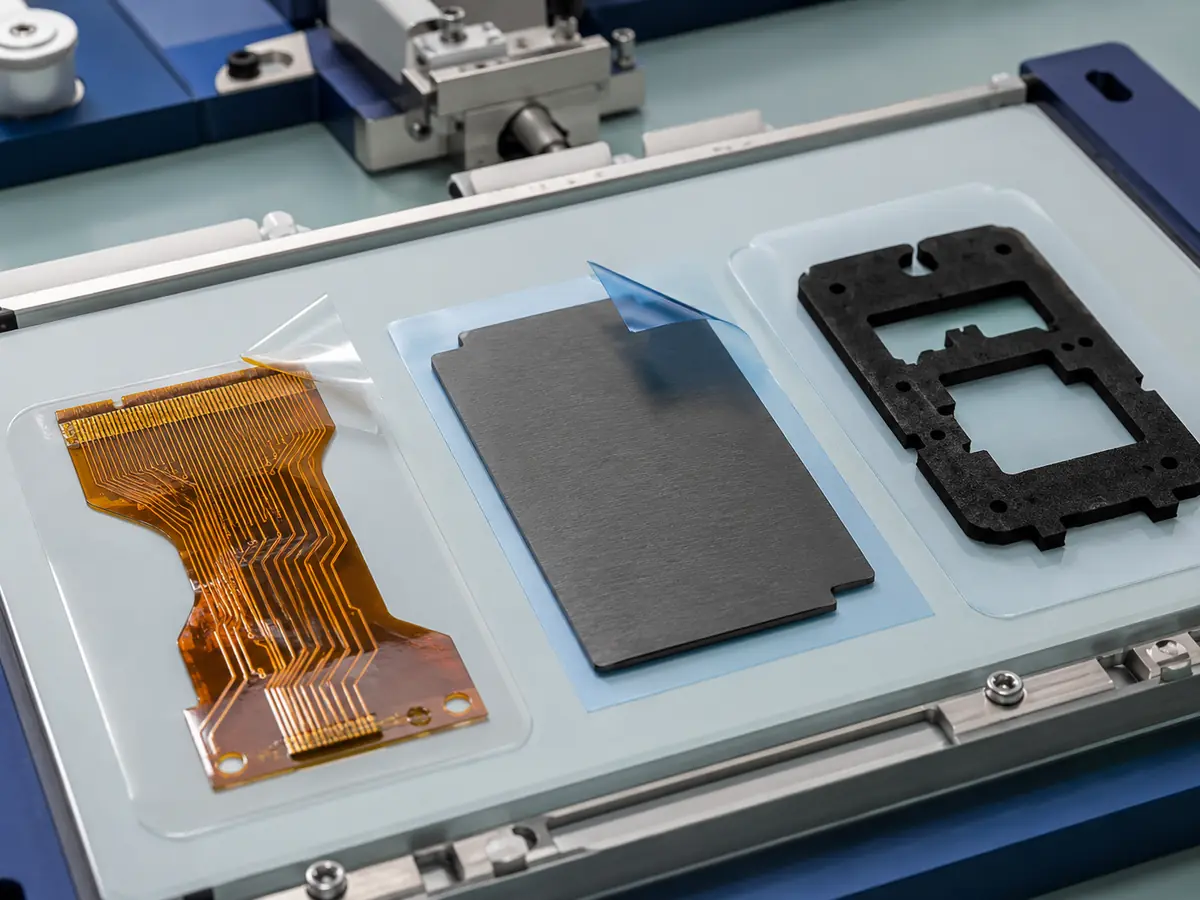
Rodziny EC-FP, EC-GR, EC-FM i EC-HT wspierają transfer, ochronę, obróbkę cieplną i czyste usuwanie z delikatnych powierzchni FPC, grafitu i pianek.
Elementy konstrukcji warstwowej materiału.
Warstwy pokazano w kolejności funkcjonalnej; dokładna konstrukcja zależy od wariantu.
- 01PET carrier
- 02Application-specific acrylic or silicone PSA
- 03Optional release liner
- 04Optional antistatic or pre-shrunk variant
Nazwane warianty do doboru technicznego.
Każdy model ECLEAR oznacza odrębną rolę materiału i konstrukcję. Odpowiedniki produkcyjne są kontrolowane w kartotece produktów ECLEAR dla zapewnienia identyfikowalności.
Adhesion is tuned to the surface and to the removal event.
01FPC, graphite and foam present different mechanical risks. Thin graphite can fracture or delaminate, flexible circuits can warp or suffer copper and coverlay damage, and cellular foam can stretch or tear when a film is removed.
02A process film therefore has a defined job: transfer, high-temperature support, die-cut carrier, waste pickup, shipment protection or temporary surface cover. Similar-looking PET films are not interchangeable when the dwell, heat exposure or removal angle changes.
03Surface roughness, porosity and cohesive strength determine the safe adhesion window. Antistatic or high-temperature variants are separate controlled grades, not universal properties of the entire family.
Wydajność oceniana w kontekście zastosowania.
Korzyści ocenia się na docelowym podłożu, w procesie i w gotowym zespole.
Coordinated films for transfer, thermal processing, converting and shipment
Controlled adhesion for smooth, matte, porous or fragile surfaces
High-temperature and antistatic variants by controlled grade
Clear removal-point definition for process traceability
Od definicji materiału do zakwalifikowanej konstrukcji produkcyjnej.
Kwalifikacja łączy materiał, sposób przetwarzania i linię produkcyjną klienta.
Transfer, heat, die cutting, shipment or temporary cover.
Record smooth/matte face, porosity, roughness and cohesive strength.
Use the full time-temperature, pressure, chemical and dwell profile.
Check residue, damage, deformation, static and surface imprint.
Dowody wymagane przed zatwierdzeniem specyfikacji.
Należy użyć reprezentatywnych podłoży, warunków procesu i sekwencji starzenia.
- Peel window on the exact smooth, matte or porous surface
- Thermal shrinkage and PSA creep through the complete process profile
- Graphite fracture, FPC delamination and foam deformation after removal
- Surface residue, ionic cleanliness and optical/cosmetic imprint
- Static generation and dissipation where ESD control is required
Każda wartość wymaga metody i zatwierdzonej rewizji.
Wartości typowe wspierają dobór; kontrolowane limity pochodzą z zatwierdzonej TDS.
Wartości typowe nie są specyfikacją. Ostateczne limity wynikają z zatwierdzonej karty TDS ECLEAR i walidacji klienta.
Pytania inżynierów przed próbą na linii.
Przed pobraniem próbek określ rolę materiału, interfejsy i okno procesu.
Why are graphite grades separated by surface face?+
Smooth and matte graphite surfaces can present different roughness, particle and adhesion behavior. A grade qualified on one face should not be assumed equivalent on the other.
Is every EC-HT film suitable for the same temperature?+
No. Time and temperature are grade-specific. Historical family data must not be converted into a blanket temperature guarantee.
Can ECLEAR recommend a grade from an application description alone?+
A first shortlist is possible, but a production recommendation requires the substrate, layer construction, equipment, process sequence, test method and acceptance criteria. ECLEAR normally moves from requirement definition to laboratory matching, samples, line trial and a frozen approved specification.
Are the values shown on this page guaranteed specifications?+
No. Website values and constructions are selection guidance. Guaranteed limits, test conditions, packaging and shelf life are controlled only by the latest ECLEAR-approved TDS, quality agreement and customer qualification record.
Obszary oceny tej platformy.
Każde zastosowanie wymaga zgodności pełnego układu warstw i walidacji linii.
Parametry wymagające kontroli.
Zapisuj pełne okno procesu, a nie tylko jedną wartość nominalną.
- Define substrate face, roughness, porosity and contamination limits.
- Document lamination pressure, dwell, temperature and removal angle.
- Use the complete thermal profile, not only peak temperature.
- Validate residue, static, deformation and surface imprint after removal.
Informacje, których potrzebujemy.
Dane te pozwalają ECLEAR zawęzić wariant i plan walidacji.
- Q1Which exact process step does the film serve?
- Q2What are the substrate surface and thickness tolerances?
- Q3What temperature, dwell and chemical exposure occur?
- Q4When and how is the film removed?
Co rzetelna próba powinna ujawnić na wczesnym etapie.
Wczesne kontrole awarii zmniejszają ryzyko skalowania i błędnych porównań.
Using a shipment film as a high-temperature carrier
Graphite delamination or fracture during stripping
Foam tearing or stretching from excessive tack
Residue, static charge or surface print-through
Kontrolowana dokumentacja techniczna.
Poproś o aktualną rewizję dla wybranego wariantu ECLEAR i zastosowania.
Typowe konstrukcje i koncepcje zastosowań służą wyłącznie do doboru materiału. Dostępność, budowa, wydajność i warunki procesu zależą od wariantu oraz podlegają najnowszej zatwierdzonej TDS ECLEAR, testom aplikacyjnym i końcowej kwalifikacji klienta.
Powiązane systemy materiałowe.
Sprawdź sąsiednie materiały współpracujące z tym produktem w tym samym układzie lub procesie.
Waliduj cały układ, a nie pojedynczy materiał.
Przekaż podłoże, konstrukcję, proces i kryteria akceptacji, aby uzyskać trafną rekomendację.