 ®
®Powłoki przeciw zarysowaniom ECLEAR do optyki z tworzyw
Typy ECLEAR-V, S, IM, TT, PA i CR obejmują powłoki termiczne, UV i dual-cure do kwalifikowanych polimerowych podłoży optycznych.
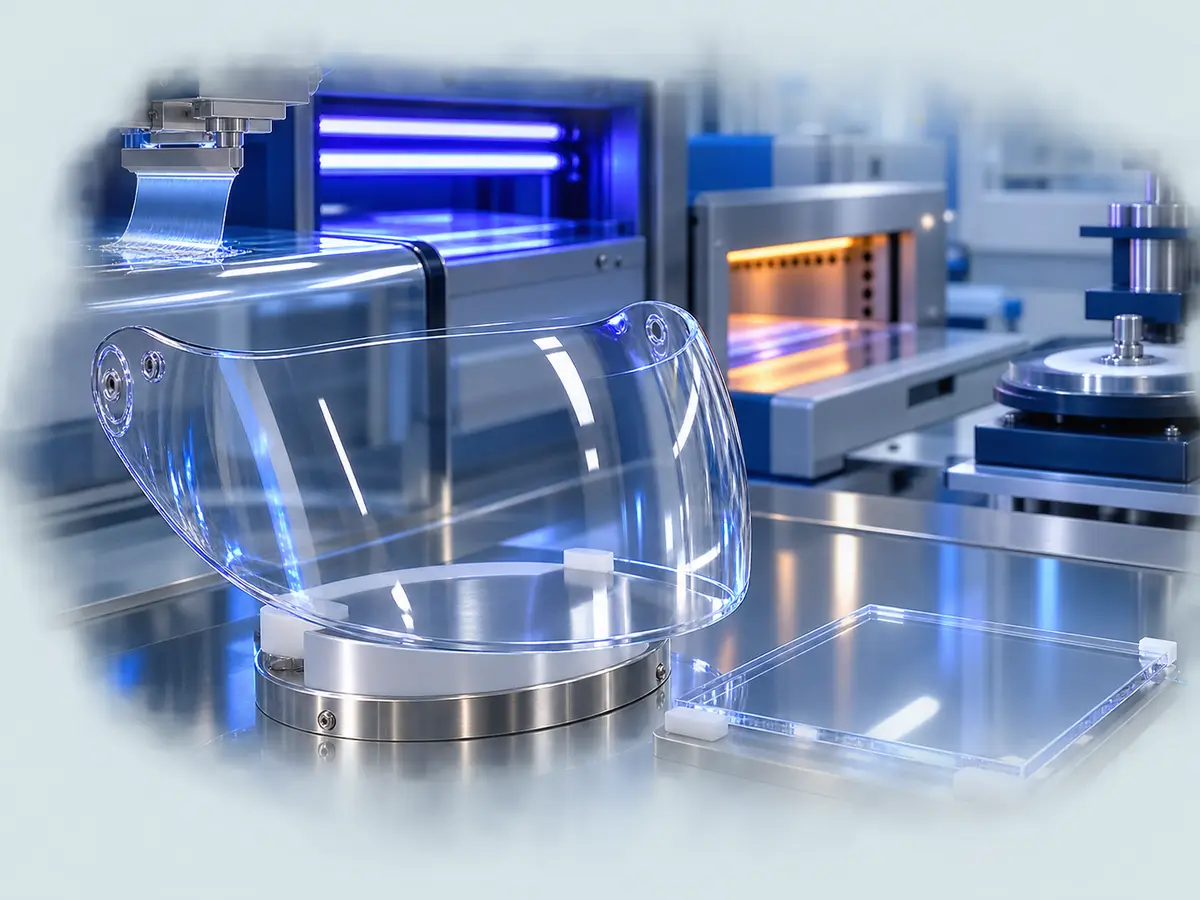
Elementy konstrukcji warstwowej materiału.
Warstwy pokazano w kolejności funkcjonalnej; dokładna konstrukcja zależy od wariantu.
- 01Prepared polymer substrate
- 02ECLEAR adhesion and curing interface
- 03Crosslinked abrasion-resistant hardcoat
- 04Optional compatible anti-fog, hydrophobic or other functional topcoat
Nazwane warianty do doboru technicznego.
Każdy model ECLEAR oznacza odrębną rolę materiału i konstrukcję. Odpowiedniki produkcyjne są kontrolowane w kartotece produktów ECLEAR dla zapewnienia identyfikowalności.
A crosslinked surface layer that protects transparent polymers.
01Uncoated thermoplastics are light and formable, but their surfaces can be vulnerable to scratching, chemicals and handling damage. A hardcoat adds a thin, optically clear network at the exposed surface while preserving the bulk properties of the molded part.
02Performance depends on more than coating chemistry. Substrate additives, residual molding stress, cleaning, wet-film uniformity, flash-off and cure history all affect adhesion and appearance. ECLEAR therefore treats the substrate, coating method and cure route as one controlled system.
03Heat-cured, UV-cured and dual-cure routes serve different geometries and manufacturing flows. Dual-cure concepts can provide a controlled pre-cure for handling or forming followed by final UV cure, but the exact sequence must be validated for the selected grade and part.
Wydajność oceniana w kontekście zastosowania.
Korzyści ocenia się na docelowym podłożu, w procesie i w gotowym zespole.
Improves scratch and abrasion resistance while maintaining optical clarity on qualified polymer substrates
Optically clear formulations for lenses, visors and molded optical parts
Heat, UV and dual-cure routes available within the wider platform
Supports flat and 3D parts made by injection molding, extrusion, casting or thermoforming
Od definicji materiału do zakwalifikowanej konstrukcji produkcyjnej.
Kwalifikacja łączy materiał, sposób przetwarzania i linię produkcyjną klienta.
Confirm resin, additives, molding stress, geometry and downstream layers.
Define cleaning, activation and contamination controls for the real part.
Control application mass, leveling, flash-off and the approved thermal or UV profile.
Test adhesion, abrasion, optics, weathering and intercoat compatibility on production geometry.
Dowody wymagane przed zatwierdzeniem specyfikacji.
Należy użyć reprezentatywnych podłoży, warunków procesu i sekwencji starzenia.
- Cross-hatch or customer-specified adhesion before and after conditioning
- Abrasion or scratch method with defined load, media and cycles
- Haze, transmittance, optical distortion and cosmetic inspection
- Humidity, thermal cycling, chemical exposure and weathering as required
- Compatibility with printing, PVD, anti-fog and easy-clean topcoats
Każda wartość wymaga metody i zatwierdzonej rewizji.
Wartości typowe wspierają dobór; kontrolowane limity pochodzą z zatwierdzonej TDS.
Wartości typowe nie są specyfikacją. Ostateczne limity wynikają z zatwierdzonej karty TDS ECLEAR i walidacji klienta.
Pytania inżynierów przed próbą na linii.
Przed pobraniem próbek określ rolę materiału, interfejsy i okno procesu.
Can one hardcoat be used on every transparent plastic?+
No. PC, PMMA, PCTG, TAC, nylon, Tritan, PET-family materials and cast lens resins differ in surface chemistry, stress sensitivity and thermal limits. The exact substrate grade must be qualified.
Does a higher pencil-hardness number guarantee better field durability?+
Not by itself. Pencil hardness, abrasion, impact, adhesion, weathering and optical quality measure different failure modes. The test package should reflect the finished product.
Can ECLEAR recommend a grade from an application description alone?+
A first shortlist is possible, but a production recommendation requires the substrate, layer construction, equipment, process sequence, test method and acceptance criteria. ECLEAR normally moves from requirement definition to laboratory matching, samples, line trial and a frozen approved specification.
Are the values shown on this page guaranteed specifications?+
No. Website values and constructions are selection guidance. Guaranteed limits, test conditions, packaging and shelf life are controlled only by the latest ECLEAR-approved TDS, quality agreement and customer qualification record.
Obszary oceny tej platformy.
Każde zastosowanie wymaga zgodności pełnego układu warstw i walidacji linii.
Parametry wymagające kontroli.
Zapisuj pełne okno procesu, a nie tylko jedną wartość nominalną.
- Confirm resin grade, molding history and residual stress before coating.
- Define cleaning, activation, coating method, flash-off, cure and post-cure as one controlled process.
- Validate optical distortion and adhesion on the final part geometry, not only a flat coupon.
- Test compatibility before applying inks, PVD layers, anti-fog or hydrophobic topcoats.
Informacje, których potrzebujemy.
Dane te pozwalają ECLEAR zawęzić wariant i plan walidacji.
- Q1What is the exact substrate resin, supplier and molding condition?
- Q2Which coating method and production capacity are required?
- Q3What abrasion, adhesion, weathering and optical tests must be passed?
- Q4Will the surface receive printing, PVD, anti-fog, photochromic, anti-reflective or easy-clean treatment?
Co rzetelna próba powinna ujawnić na wczesnym etapie.
Wczesne kontrole awarii zmniejszają ryzyko skalowania i błędnych porównań.
Residual stress cracking or solvent attack on an unverified substrate
Incomplete cure, intercoat incompatibility or adhesion loss
Flow marks, edge build-up or optical distortion on complex geometry
Over-generalizing a laboratory result to a customer production line
Kontrolowana dokumentacja techniczna.
Poproś o aktualną rewizję dla wybranego wariantu ECLEAR i zastosowania.
Typowe konstrukcje i koncepcje zastosowań służą wyłącznie do doboru materiału. Dostępność, budowa, wydajność i warunki procesu zależą od wariantu oraz podlegają najnowszej zatwierdzonej TDS ECLEAR, testom aplikacyjnym i końcowej kwalifikacji klienta.
Powiązane systemy materiałowe.
Sprawdź sąsiednie materiały współpracujące z tym produktem w tym samym układzie lub procesie.
Waliduj cały układ, a nie pojedynczy materiał.
Przekaż podłoże, konstrukcję, proces i kryteria akceptacji, aby uzyskać trafną rekomendację.