 ®
®EV Battery & Semiconductor Process Materials
Consulte los modelos ECLEAR, la construcción del material, las aplicaciones, la ventana de proceso y los requisitos de validación de esta familia técnica.
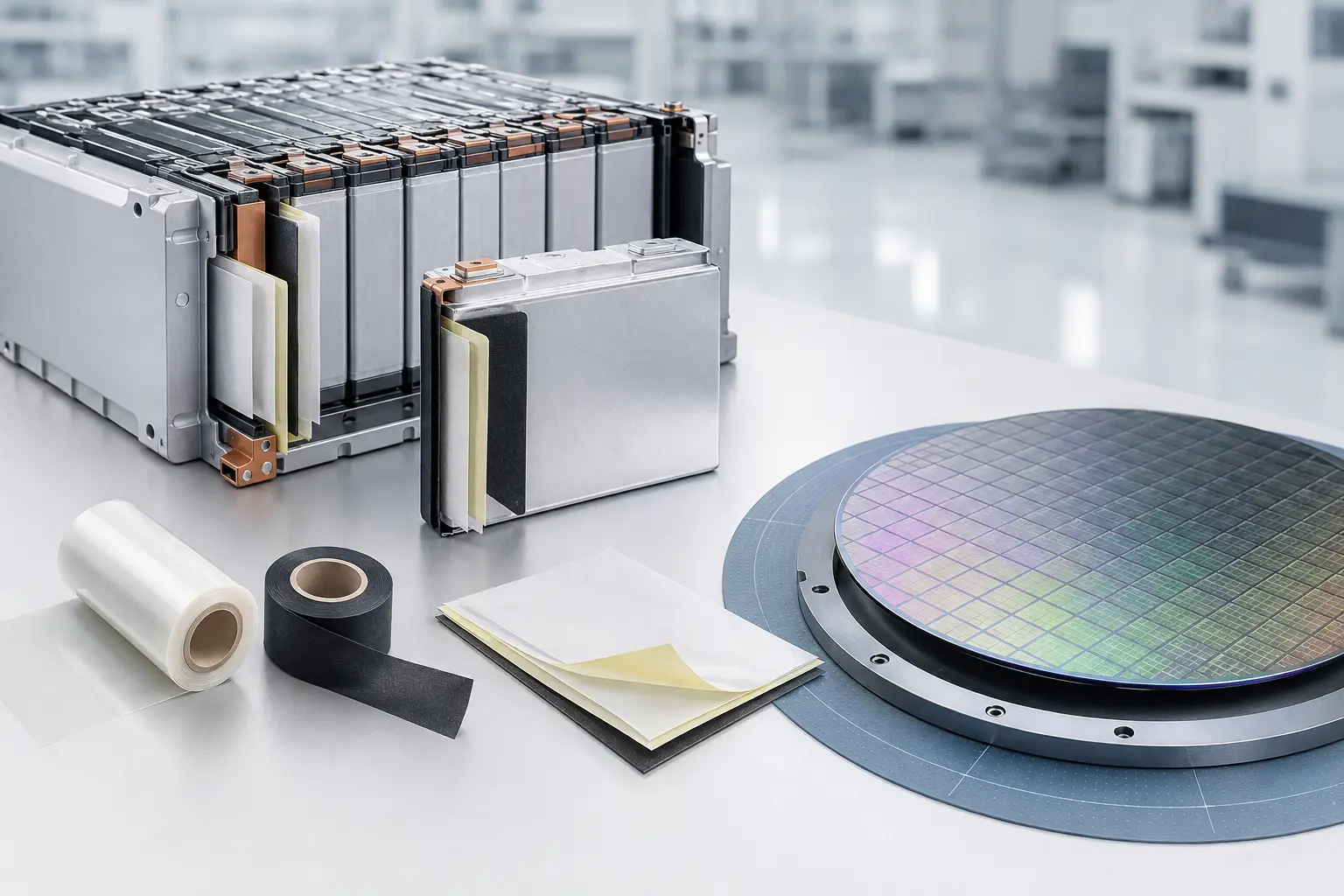
Qué contiene la estructura del material.
Las capas se presentan en orden funcional; la construcción exacta depende de cada grado.
- 01EV: application-specific insulation, flame-retardant, electrode and termination tapes/films
- 02Fuel cell: release liner / silicone adhesive / PEN film
- 03Semiconductor temporary tapes: carrier / responsive PSA / liner by process
- 04Permanent die-attach film: controlled adhesive stack; other thermal-process films: function and removal step require confirmation
Grados identificados para la selección técnica.
Cada modelo ECLEAR representa una función y una construcción distintas. Las referencias de fabricación se controlan en el maestro de productos ECLEAR para garantizar la trazabilidad.
Material role must remain explicit across energy and wafer processes.
01EV materials may remain permanently as electrical insulation, flame-control support, fixation, cushioning or structural bonding. Semiconductor materials can be temporary process tapes for grinding, de-taping, dicing and singulation, or permanent films such as selected die-attach materials.
02The same words—film, tape or release—can refer to very different lifecycle roles. Each drawing and process flow must state whether the material remains in the product, how it is activated and at which step it is removed.
03Electrical, thermal, chemical and mechanical performance are stack-level properties. Flame, dielectric, electrolyte, UV-release and wafer-pick claims require a defined standard, thickness, process and final-customer qualification.
Rendimiento definido por la aplicación.
Las ventajas se evalúan sobre el sustrato, el proceso y el conjunto final previstos.
Clear separation of temporary process films and permanent functional layers
Material families for cell, module, CCS and pack-level needs
Thin PEN-based fuel-cell insulation/fixation option
Process-tape coverage from wafer thinning through package singulation
De la definición del material a una estructura de producción homologada.
La homologación vincula el material, la conversión y la línea de producción del cliente.
Permanent insulation/bonding or temporary process support and its removal step.
Set voltage, heat, chemicals, compression, wafer process and activation route.
Freeze thickness, coverage, edge design, dose/heat and equipment settings.
Test electrical, thermal, release, cleanliness and package reliability.
Evidencias necesarias antes de aprobar la especificación.
Utilice sustratos, condiciones de proceso y secuencias de envejecimiento representativos.
- Dielectric, insulation and edge-coverage evaluation in the EV assembly
- Thermal, flame and chemical testing to the named standard and thickness
- UV or thermal release including shadow, edge and aged conditions
- Wafer breakage, die fly, pick force, residue, low-k and ESD checks
- DAF bondline, void, warpage, cure and package reliability where applicable
Todo valor necesita un método y una revisión aprobada.
Los valores típicos orientan la selección; las especificaciones controladas proceden de la TDS aprobada.
Los valores típicos no son especificaciones. Los límites finales dependen de la TDS ECLEAR aprobada y de la validación del cliente.
Preguntas de ingeniería antes de una prueba en línea.
Defina la función, las interfaces y la ventana de proceso antes de solicitar muestras.
How are EV and semiconductor material grades specified?+
ECLEAR publishes the applicable family and named grade where the construction is defined. The current controlled TDS then governs thickness, adhesive or film chemistry, process window, packaging and qualification for the intended line.
Can UV-debonding data be transferred between tools?+
No. Spectrum, irradiance, dose uniformity, substrate transmission and shadow areas can change the release result. The customer tool and full process must be validated.
Can ECLEAR recommend a grade from an application description alone?+
A first shortlist is possible, but a production recommendation requires the substrate, layer construction, equipment, process sequence, test method and acceptance criteria. ECLEAR normally moves from requirement definition to laboratory matching, samples, line trial and a frozen approved specification.
Are the values shown on this page guaranteed specifications?+
No. Website values and constructions are selection guidance. Guaranteed limits, test conditions, packaging and shelf life are controlled only by the latest ECLEAR-approved TDS, quality agreement and customer qualification record.
Ámbitos de evaluación de esta plataforma.
Cada aplicación requiere comprobar la compatibilidad de la estructura y validar la línea.
Parámetros que deben controlarse.
Registre la ventana de proceso completa, no solo un ajuste nominal.
- Map the material role and removal step in the full process flow.
- Validate electrical, chemical, thermal and aging requirements in the customer stack.
- For process tapes, control dose or thermal activation and shadow/edge zones.
- For permanent films, qualify cure, bondline and package reliability.
Información que necesitamos.
Estos datos permiten a ECLEAR limitar el grado y preparar el plan de validación.
- Q1Does the material remain in the product or leave during processing?
- Q2What voltage, temperature, flame and chemical environment applies?
- Q3Which process tool, activation route and cycle are used?
- Q4Which regulatory and customer standards control release?
Fallos que una prueba rigurosa debe revelar pronto.
Las verificaciones tempranas reducen el riesgo de escalado y las comparaciones erróneas.
Publishing family-level claims as a grade specification
Mixing temporary dicing tape with permanent die-attach film
Incomplete release in shadow areas or after thermal aging
Electrical or chemical failure from stack-level incompatibility
Documentos técnicos controlados.
Solicite la revisión vigente para el grado ECLEAR y la aplicación seleccionados.
Las construcciones típicas y los conceptos de aplicación se facilitan solo para seleccionar materiales. La disponibilidad, la estructura, el rendimiento y las condiciones de proceso dependen del grado y están sujetos a la TDS ECLEAR vigente, las pruebas de aplicación y la homologación final del cliente.
Sistemas de materiales relacionados.
Revise los materiales adyacentes que interactúan con este producto en la misma estructura o proceso.
Valide la estructura completa, no un material aislado.
Comparta el sustrato, la construcción, el proceso y los criterios de aceptación para recibir una recomendación precisa.