 ®
®ECLEAR Anti-Scratch Hard Coatings
Consulte los modelos ECLEAR, la construcción del material, las aplicaciones, la ventana de proceso y los requisitos de validación de esta familia técnica.
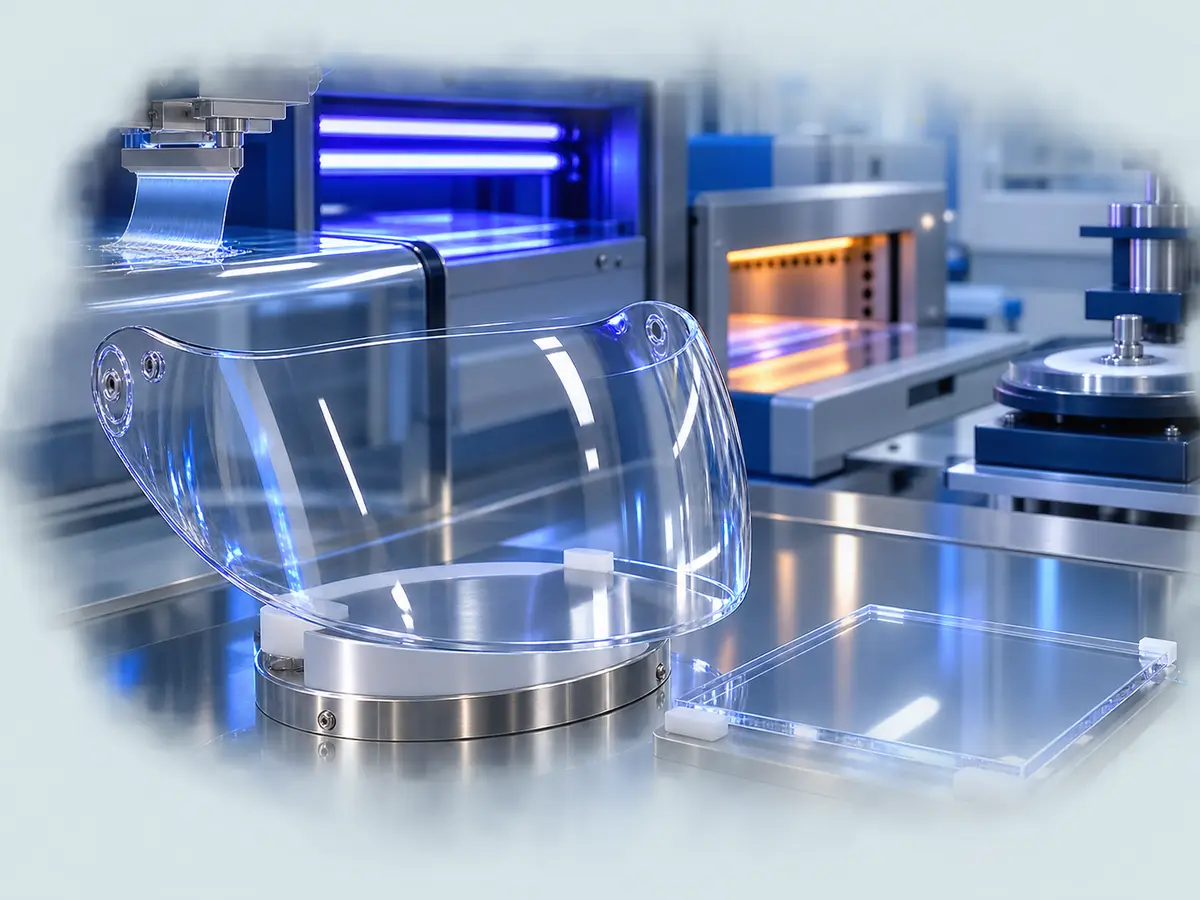
Qué contiene la estructura del material.
Las capas se presentan en orden funcional; la construcción exacta depende de cada grado.
- 01Prepared polymer substrate
- 02ECLEAR adhesion and curing interface
- 03Crosslinked abrasion-resistant hardcoat
- 04Optional compatible anti-fog, hydrophobic or other functional topcoat
Grados identificados para la selección técnica.
Cada modelo ECLEAR representa una función y una construcción distintas. Las referencias de fabricación se controlan en el maestro de productos ECLEAR para garantizar la trazabilidad.
A crosslinked surface layer that protects transparent polymers.
01Uncoated thermoplastics are light and formable, but their surfaces can be vulnerable to scratching, chemicals and handling damage. A hardcoat adds a thin, optically clear network at the exposed surface while preserving the bulk properties of the molded part.
02Performance depends on more than coating chemistry. Substrate additives, residual molding stress, cleaning, wet-film uniformity, flash-off and cure history all affect adhesion and appearance. ECLEAR therefore treats the substrate, coating method and cure route as one controlled system.
03Heat-cured, UV-cured and dual-cure routes serve different geometries and manufacturing flows. Dual-cure concepts can provide a controlled pre-cure for handling or forming followed by final UV cure, but the exact sequence must be validated for the selected grade and part.
Rendimiento definido por la aplicación.
Las ventajas se evalúan sobre el sustrato, el proceso y el conjunto final previstos.
Improves scratch and abrasion resistance while maintaining optical clarity on qualified polymer substrates
Optically clear formulations for lenses, visors and molded optical parts
Heat, UV and dual-cure routes available within the wider platform
Supports flat and 3D parts made by injection molding, extrusion, casting or thermoforming
De la definición del material a una estructura de producción homologada.
La homologación vincula el material, la conversión y la línea de producción del cliente.
Confirm resin, additives, molding stress, geometry and downstream layers.
Define cleaning, activation and contamination controls for the real part.
Control application mass, leveling, flash-off and the approved thermal or UV profile.
Test adhesion, abrasion, optics, weathering and intercoat compatibility on production geometry.
Evidencias necesarias antes de aprobar la especificación.
Utilice sustratos, condiciones de proceso y secuencias de envejecimiento representativos.
- Cross-hatch or customer-specified adhesion before and after conditioning
- Abrasion or scratch method with defined load, media and cycles
- Haze, transmittance, optical distortion and cosmetic inspection
- Humidity, thermal cycling, chemical exposure and weathering as required
- Compatibility with printing, PVD, anti-fog and easy-clean topcoats
Todo valor necesita un método y una revisión aprobada.
Los valores típicos orientan la selección; las especificaciones controladas proceden de la TDS aprobada.
Los valores típicos no son especificaciones. Los límites finales dependen de la TDS ECLEAR aprobada y de la validación del cliente.
Preguntas de ingeniería antes de una prueba en línea.
Defina la función, las interfaces y la ventana de proceso antes de solicitar muestras.
Can one hardcoat be used on every transparent plastic?+
No. PC, PMMA, PCTG, TAC, nylon, Tritan, PET-family materials and cast lens resins differ in surface chemistry, stress sensitivity and thermal limits. The exact substrate grade must be qualified.
Does a higher pencil-hardness number guarantee better field durability?+
Not by itself. Pencil hardness, abrasion, impact, adhesion, weathering and optical quality measure different failure modes. The test package should reflect the finished product.
Can ECLEAR recommend a grade from an application description alone?+
A first shortlist is possible, but a production recommendation requires the substrate, layer construction, equipment, process sequence, test method and acceptance criteria. ECLEAR normally moves from requirement definition to laboratory matching, samples, line trial and a frozen approved specification.
Are the values shown on this page guaranteed specifications?+
No. Website values and constructions are selection guidance. Guaranteed limits, test conditions, packaging and shelf life are controlled only by the latest ECLEAR-approved TDS, quality agreement and customer qualification record.
Ámbitos de evaluación de esta plataforma.
Cada aplicación requiere comprobar la compatibilidad de la estructura y validar la línea.
Parámetros que deben controlarse.
Registre la ventana de proceso completa, no solo un ajuste nominal.
- Confirm resin grade, molding history and residual stress before coating.
- Define cleaning, activation, coating method, flash-off, cure and post-cure as one controlled process.
- Validate optical distortion and adhesion on the final part geometry, not only a flat coupon.
- Test compatibility before applying inks, PVD layers, anti-fog or hydrophobic topcoats.
Información que necesitamos.
Estos datos permiten a ECLEAR limitar el grado y preparar el plan de validación.
- Q1What is the exact substrate resin, supplier and molding condition?
- Q2Which coating method and production capacity are required?
- Q3What abrasion, adhesion, weathering and optical tests must be passed?
- Q4Will the surface receive printing, PVD, anti-fog, photochromic, anti-reflective or easy-clean treatment?
Fallos que una prueba rigurosa debe revelar pronto.
Las verificaciones tempranas reducen el riesgo de escalado y las comparaciones erróneas.
Residual stress cracking or solvent attack on an unverified substrate
Incomplete cure, intercoat incompatibility or adhesion loss
Flow marks, edge build-up or optical distortion on complex geometry
Over-generalizing a laboratory result to a customer production line
Documentos técnicos controlados.
Solicite la revisión vigente para el grado ECLEAR y la aplicación seleccionados.
Las construcciones típicas y los conceptos de aplicación se facilitan solo para seleccionar materiales. La disponibilidad, la estructura, el rendimiento y las condiciones de proceso dependen del grado y están sujetos a la TDS ECLEAR vigente, las pruebas de aplicación y la homologación final del cliente.
Sistemas de materiales relacionados.
Revise los materiales adyacentes que interactúan con este producto en la misma estructura o proceso.
Valide la estructura completa, no un material aislado.
Comparta el sustrato, la construcción, el proceso y los criterios de aceptación para recibir una recomendación precisa.