 ®
®OCA Converting, Carrier & Release Solutions
Consulte los modelos ECLEAR, la construcción del material, las aplicaciones, la ventana de proceso y los requisitos de validación de esta familia técnica.
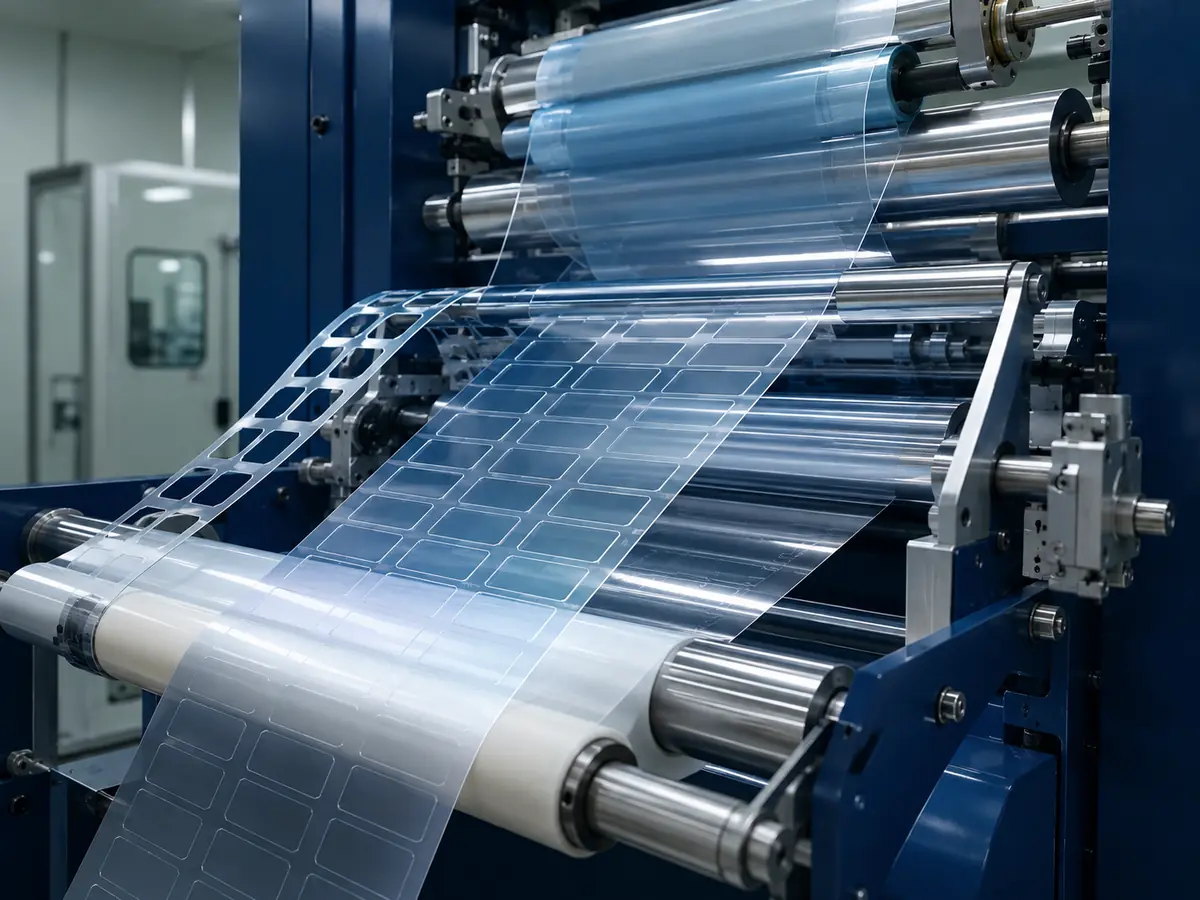
Qué contiene la estructura del material.
Las capas se presentan en orden funcional; la construcción exacta depende de cada grado.
- 01OCA master roll with controlled light/heavy liners
- 02Micro-textured or smooth PET carrier with low-tack PSA
- 03Controlled-tack PET waste-stripping film
- 04Silicone, fluorinated or silicone-free release liner matched to adhesive chemistry
Grados identificados para la selección técnica.
Cada modelo ECLEAR representa una función y una construcción distintas. Las referencias de fabricación se controlan en el maestro de productos ECLEAR para garantizar la trazabilidad.
Temporary films control a permanent adhesive through converting.
01OCA is the permanent optical adhesive. Carriers, waste-stripping films and release liners are temporary process materials that stabilize it until the correct removal step. Confusing these roles can lead to the wrong drawing, liner sequence or customer instruction.
02During rotary or flatbed die cutting, the carrier controls dimensions and supports the soft adhesive. A waste film must lift the intended matrix without lifting finished parts. Release liners must provide a stable light/heavy relationship after dwell, storage and thermal history.
03Release force is not an intrinsic number without a method. Reference tape, roller, dwell, temperature, humidity, peel angle and speed must accompany every reported result.
Rendimiento definido por la aplicación.
Las ventajas se evalúan sobre el sustrato, el proceso y el conjunto final previstos.
Separates permanent OCA from temporary converting materials
Supports dimensional control and clean liner exchange
Helps manage adhesive edge squeeze, particles and trapped air
Release system selected to the actual acrylic or silicone adhesive
De la definición del material a una estructura de producción homologada.
La homologación vincula el material, la conversión y la línea de producción del cliente.
Identify OCA, light/heavy liner, carrier, waste film and the removal order.
Set web tension, lamination pressure, die depth and registration.
Balance waste pickup with part retention and clean liner exchange.
Qualify particles, edge deformation, release aging and customer handling.
Evidencias necesarias antes de aprobar la especificación.
Utilice sustratos, condiciones de proceso y secuencias de envejecimiento representativos.
- Carrier peel and dimensional stability through the die-cut sequence
- Waste-stripping margin across web speed and stripping geometry
- Light/heavy release after dwell, heat aging and storage
- Particle, residue, silicone-transfer and static-control inspection
- OCA edge shape, bubble performance and liner orientation on the customer line
Todo valor necesita un método y una revisión aprobada.
Los valores típicos orientan la selección; las especificaciones controladas proceden de la TDS aprobada.
Los valores típicos no son especificaciones. Los límites finales dependen de la TDS ECLEAR aprobada y de la validación del cliente.
Preguntas de ingeniería antes de una prueba en línea.
Defina la función, las interfaces y la ventana de proceso antes de solicitar muestras.
Is EC-OC an optically clear adhesive?+
No. EC-OC identifies the OCA carrier family. EC-OA identifies permanent OCA optical adhesive. The different codes intentionally prevent a process carrier from being confused with the adhesive itself.
Can silicone release liner be used with every OCA?+
No. Acrylic and silicone adhesive systems can require different release chemistries. Fluorinated or silicone-free liners are selected only after compatibility and contamination review.
Can ECLEAR recommend a grade from an application description alone?+
A first shortlist is possible, but a production recommendation requires the substrate, layer construction, equipment, process sequence, test method and acceptance criteria. ECLEAR normally moves from requirement definition to laboratory matching, samples, line trial and a frozen approved specification.
Are the values shown on this page guaranteed specifications?+
No. Website values and constructions are selection guidance. Guaranteed limits, test conditions, packaging and shelf life are controlled only by the latest ECLEAR-approved TDS, quality agreement and customer qualification record.
Ámbitos de evaluación de esta plataforma.
Cada aplicación requiere comprobar la compatibilidad de la estructura y validar la línea.
Parámetros que deben controlarse.
Registre la ventana de proceso completa, no solo un ajuste nominal.
- Map every liner and process film to the exact removal step.
- Validate unwind, lamination pressure, die depth, web tension and stripping angle.
- Test release after representative dwell, aging and storage.
- Approve particles, residue, adhesive deformation and bubble performance on the customer line.
Información que necesitamos.
Estos datos permiten a ECLEAR limitar el grado y preparar el plan de validación.
- Q1What is the OCA chemistry, thickness and original liner construction?
- Q2Which face is light release and which is heavy release?
- Q3What die-cut sequence, web speed and waste geometry are used?
- Q4What cleanliness, static-control and sheet-delivery requirements apply?
Fallos que una prueba rigurosa debe revelar pronto.
Las verificaciones tempranas reducen el riesgo de escalado y las comparaciones erróneas.
Confusing the permanent OCA with its temporary carrier
Waste film lifting finished parts
Release-force drift after heat or aging
Silicone transfer or contamination in a restricted process
Documentos técnicos controlados.
Solicite la revisión vigente para el grado ECLEAR y la aplicación seleccionados.
Las construcciones típicas y los conceptos de aplicación se facilitan solo para seleccionar materiales. La disponibilidad, la estructura, el rendimiento y las condiciones de proceso dependen del grado y están sujetos a la TDS ECLEAR vigente, las pruebas de aplicación y la homologación final del cliente.
Sistemas de materiales relacionados.
Revise los materiales adyacentes que interactúan con este producto en la misma estructura o proceso.
Valide la estructura completa, no un material aislado.
Comparta el sustrato, la construcción, el proceso y los criterios de aceptación para recibir una recomendación precisa.