 ®
®ECLEAR Kratzschutz-Hardcoats für optische Kunststoffe
Die Typen ECLEAR-V, S, IM, TT, PA und CR umfassen thermische, UV- und Dual-Cure-Hardcoats für qualifizierte optische Polymersubstrate.
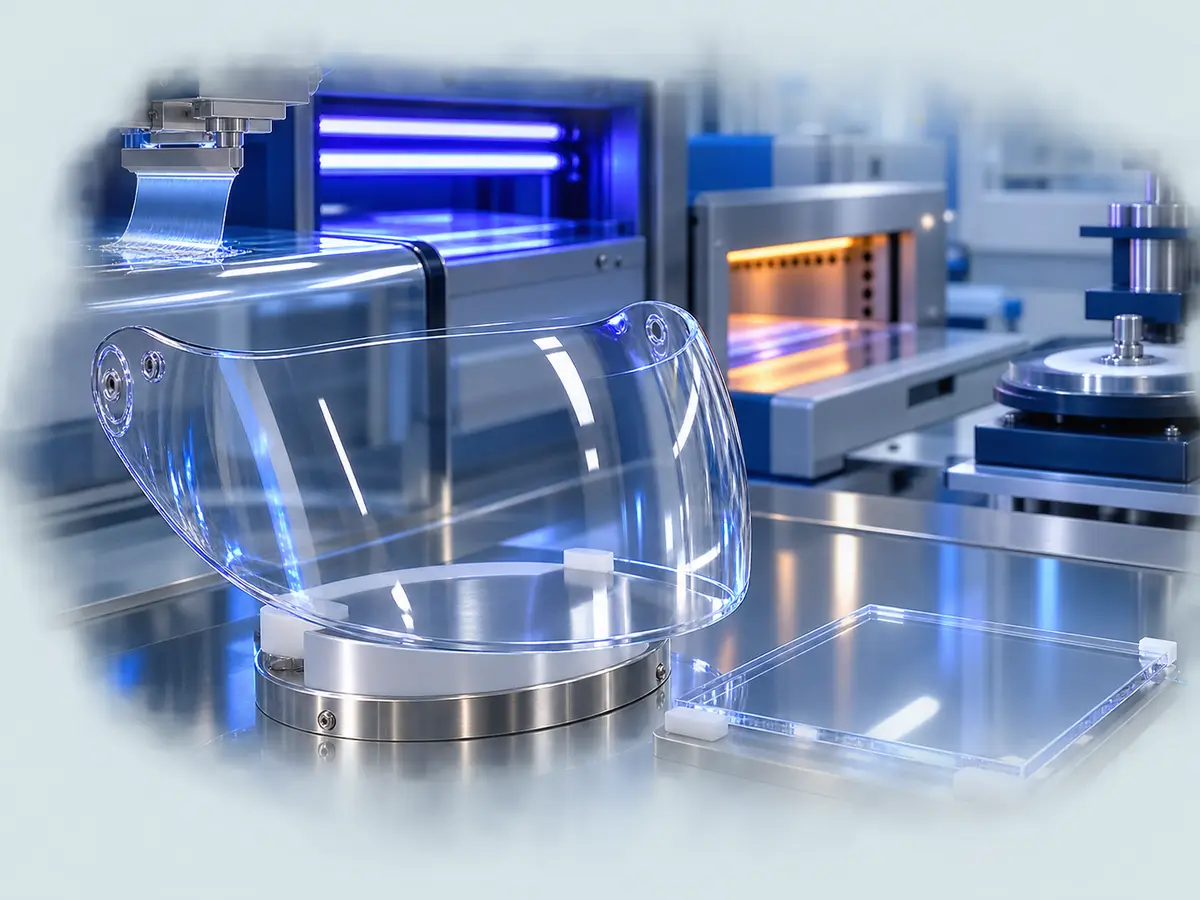
Bestandteile des Materialaufbaus.
Die Schichten sind in Funktionsreihenfolge dargestellt; der genaue Aufbau ist variantenspezifisch.
- 01Prepared polymer substrate
- 02ECLEAR adhesion and curing interface
- 03Crosslinked abrasion-resistant hardcoat
- 04Optional compatible anti-fog, hydrophobic or other functional topcoat
Benannte Varianten für die technische Auswahl.
Jedes ECLEAR-Modell steht für eine eigene Materialfunktion und Konstruktion. Fertigungszuordnungen werden zur Rückverfolgbarkeit im ECLEAR-Produktstamm kontrolliert geführt.
A crosslinked surface layer that protects transparent polymers.
01Uncoated thermoplastics are light and formable, but their surfaces can be vulnerable to scratching, chemicals and handling damage. A hardcoat adds a thin, optically clear network at the exposed surface while preserving the bulk properties of the molded part.
02Performance depends on more than coating chemistry. Substrate additives, residual molding stress, cleaning, wet-film uniformity, flash-off and cure history all affect adhesion and appearance. ECLEAR therefore treats the substrate, coating method and cure route as one controlled system.
03Heat-cured, UV-cured and dual-cure routes serve different geometries and manufacturing flows. Dual-cure concepts can provide a controlled pre-cure for handling or forming followed by final UV cure, but the exact sequence must be validated for the selected grade and part.
Leistung im Kontext der Anwendung.
Vorteile werden auf dem vorgesehenen Substrat, im Prozess und in der Endbaugruppe bewertet.
Improves scratch and abrasion resistance while maintaining optical clarity on qualified polymer substrates
Optically clear formulations for lenses, visors and molded optical parts
Heat, UV and dual-cure routes available within the wider platform
Supports flat and 3D parts made by injection molding, extrusion, casting or thermoforming
Von der Materialdefinition zum qualifizierten Produktionsaufbau.
Die Qualifizierung verbindet Material, Verarbeitung und Kundenproduktionslinie.
Confirm resin, additives, molding stress, geometry and downstream layers.
Define cleaning, activation and contamination controls for the real part.
Control application mass, leveling, flash-off and the approved thermal or UV profile.
Test adhesion, abrasion, optics, weathering and intercoat compatibility on production geometry.
Nachweise vor der Freigabe der Spezifikation.
Verwenden Sie repräsentative Substrate, Prozessbedingungen und Alterungsfolgen.
- Cross-hatch or customer-specified adhesion before and after conditioning
- Abrasion or scratch method with defined load, media and cycles
- Haze, transmittance, optical distortion and cosmetic inspection
- Humidity, thermal cycling, chemical exposure and weathering as required
- Compatibility with printing, PVD, anti-fog and easy-clean topcoats
Werte benötigen eine Methode und einen freigegebenen Revisionsstand.
Typische Werte unterstützen die Auswahl; kontrollierte Grenzen stammen aus der freigegebenen TDS.
Typische Werte sind keine Spezifikationen. Endgültige Grenzwerte unterliegen dem freigegebenen ECLEAR-TDS und der Kundenvalidierung.
Fragen der Ingenieure vor einem Linienversuch.
Klären Sie Materialfunktion, Grenzflächen und Prozessfenster vor der Bemusterung.
Can one hardcoat be used on every transparent plastic?+
No. PC, PMMA, PCTG, TAC, nylon, Tritan, PET-family materials and cast lens resins differ in surface chemistry, stress sensitivity and thermal limits. The exact substrate grade must be qualified.
Does a higher pencil-hardness number guarantee better field durability?+
Not by itself. Pencil hardness, abrasion, impact, adhesion, weathering and optical quality measure different failure modes. The test package should reflect the finished product.
Can ECLEAR recommend a grade from an application description alone?+
A first shortlist is possible, but a production recommendation requires the substrate, layer construction, equipment, process sequence, test method and acceptance criteria. ECLEAR normally moves from requirement definition to laboratory matching, samples, line trial and a frozen approved specification.
Are the values shown on this page guaranteed specifications?+
No. Website values and constructions are selection guidance. Guaranteed limits, test conditions, packaging and shelf life are controlled only by the latest ECLEAR-approved TDS, quality agreement and customer qualification record.
Anwendungsfelder dieser Plattform.
Jede Anwendung erfordert weiterhin die Kompatibilität des Gesamtaufbaus und eine Linienvalidierung.
Zu kontrollierende Parameter.
Dokumentieren Sie das vollständige Prozessfenster und nicht nur einen Nennwert.
- Confirm resin grade, molding history and residual stress before coating.
- Define cleaning, activation, coating method, flash-off, cure and post-cure as one controlled process.
- Validate optical distortion and adhesion on the final part geometry, not only a flat coupon.
- Test compatibility before applying inks, PVD layers, anti-fog or hydrophobic topcoats.
Welche Angaben wir benötigen.
Mit diesen Daten kann ECLEAR die Variante und den Validierungsplan eingrenzen.
- Q1What is the exact substrate resin, supplier and molding condition?
- Q2Which coating method and production capacity are required?
- Q3What abrasion, adhesion, weathering and optical tests must be passed?
- Q4Will the surface receive printing, PVD, anti-fog, photochromic, anti-reflective or easy-clean treatment?
Was ein disziplinierter Versuch frühzeitig aufdecken sollte.
Frühe Fehlerprüfungen reduzieren Skalierungsrisiken und falsche Materialvergleiche.
Residual stress cracking or solvent attack on an unverified substrate
Incomplete cure, intercoat incompatibility or adhesion loss
Flow marks, edge build-up or optical distortion on complex geometry
Over-generalizing a laboratory result to a customer production line
Kontrollierte technische Dokumente.
Fordern Sie den aktuellen Stand für die gewählte ECLEAR-Variante und Anwendung an.
Typische Aufbauten und Anwendungskonzepte dienen ausschließlich der Materialauswahl. Verfügbarkeit, Aufbau, Leistung und Prozessbedingungen sind variantenspezifisch und unterliegen der neuesten freigegebenen ECLEAR-TDS, den Anwendungstests und der abschließenden Kundenqualifizierung.
Verwandte Materialsysteme.
Prüfen Sie angrenzende Materialien, die im selben Aufbau oder Prozess mit diesem Produkt zusammenwirken.
Validieren Sie den Gesamtaufbau, nicht nur ein einzelnes Material.
Teilen Sie Substrat, Aufbau, Prozess und Abnahmekriterien für eine gezielte Empfehlung mit.